| Previous day | 
|
Next day |
| Old Style
August 14
|
Sunday |
New Style
August 27
|
|
12th Sunday after Pentecost.
Tone 3.
Успенский пост. |
 Wine and oil allowed.
|
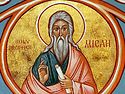
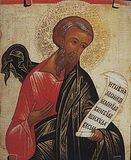
 Forefeast of the Dormition. Prophet Micah (8th c. b.c.).
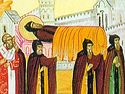
  Translation of the relics of St. Theodosius of the Kiev Caves (1091).
Hieromartyr Marcellus, bishop of Apamea (ca. 389). Translation of the relics of St. Arcadius, monk, of Novotorzhok (1798). Commemoration of the disciples of St. Tikhon of Zadonsk: Monks Theophanes, Aaron, Nicander, Cosmas, and Metrophanes (18th-19th c.).
New Hieromartyr Basil (Bogoyavlensky), archbishop of Chernigov, and with him New Monk-martyr Matthew and New Martyr Alexis (1918). New Hieromartyrs Nazarius, metropolitan of Kutaisi, Georgia, and with him priests Herman, Hierotheus, and Simon, and archdeacon Bessarion (1924). Synaxis of the New Martyrs of Georgia who suffered under the Atheist Yoke (20th c.). New Hieromartyrs Matthew (Pomerantsev), archimandrite, of Perm (1918), and Eleutherius (Pechennikov), schema-archimandrite, of the Holy Trinity Monastery (Smolensk) (1937). New Martyr Eve (Pavlova), abbess of Holy Trinity Convent in Penza (Saratov) (1937).
Martyr Ursicius, at Illyricum (305-313). St. Fachanan, abbot, of Ross Carbery, Cork (ca. 600). New Martyr Symeon of Trebizond, at Constantinople (1653).
Repose of Archimandrite Theodosius (Makkos) of Bethany (1991).
Thoughts for Each Day of the Year
According to the Daily Church Readings from the Word of God
By St. Theophan the Recluse

Twelfth Sunday After Pentecost. [I Cor. 15:1-11; Matt. 19:16-26]
A rich man shall hardly enter into the Kingdom of Heaven. Here is meant a rich man who sees in his own self many methods and many powers unto his own prosperity. But as soon as one who has many possessions cuts off all attachment to them, extinguishes within himself all reliance on them, and ceases to see them as his substantial support, then in his heart he is the same as one who possesses nothing—for thus is the road to the kingdom open. Riches are then not only a hindrance, but a help, for they provide the means for charitable works. Riches are not the misfortune, but rather reliance upon them and attachment to them. This thought can be generalized in this way: whoever relies on something and is attached to something is rich in that thing. Whoever relies on God alone and cleaves to Him with all his heart is rich in God, Whoever relies on something else turns his heart to it instead of God—such a person is rich in this other thing, but not in God. From this it follows that he who is not rich in God has no entrance into the kingdom of God. Here are meant such things as birth, connections, mind, rank, circle of activities and so forth.
Twelfth Sunday After Pentecost. [I Cor. 15:1-11; Matt. 19:16-26]
A rich man shall hardly enter into the Kingdom of Heaven. Here is meant a rich man who sees in his own self many methods and many powers unto his own prosperity. But as soon as one who has many possessions cuts off all attachment to them, extinguishes within himself all reliance on them, and ceases to see them as his substantial support, then in his heart he is the same as one who possesses nothing—for thus is the road to the kingdom open. Riches are then not only a hindrance, but a help, for they provide the means for charitable works. Riches are not the misfortune, but rather reliance upon them and attachment to them. This thought can be generalized in this way: whoever relies on something and is attached to something is rich in that thing. Whoever relies on God alone and cleaves to Him with all his heart is rich in God, Whoever relies on something else turns his heart to it instead of God—such a person is rich in this other thing, but not in God. From this it follows that he who is not rich in God has no entrance into the kingdom of God. Here are meant such things as birth, connections, mind, rank, circle of activities and so forth.
Articles