| Previous day | 
|
Next day |
| Old Style
September 13
|
Tuesday |
New Style
September 26
|
| 17th Week after Pentecost. Tone 7. |  No fast.
|
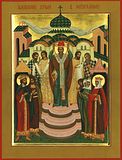
 Commemoration of the Founding of the Church of the Resurrection (the Holy Sepulchre) at Jerusalem (335).
  Forefeast of the Exaltation of the Cross. Hieromartyr Cornelius the Centurion (1st c.).
Martyrs Serapion, Cronides, and Leontius, of Alexandria (ca. 237). Martyr Straton of Nicomedia (3rd c.). Martyr Seleucus of Galatia (320). Martyrs Elias, Zoticus, Lucian, Valerian, Macrobius, and Gordian, at Tomis in Moesia (320). Great-martyr Ketevan, queen of Kakheti, Georgia (1624). St. Cornelius of Padan-Olonets, disciple of St. Alexander of Svir, and with him Sts. Dionysius and Misael (16th c).
St. Litorius, bishop of Tours (370). St. Eulogius I, patriarch of Alexandria (608). St. John of Prislop (Romania) (15th-16th c.). St. Hierotheus of Kalamata, monk of Iveron, Mt. Athos (1745).
Repose of Monk Dorotheus, last hermit of the Roslavl Forests (1866).
Thoughts for Each Day of the Year
According to the Daily Church Readings from the Word of God
By St. Theophan the Recluse

Tuesday. [Eph. 2:19-3:7; Mark 11:11-23]
The fig tree covered with leaves was splendid in appearance, but was not honoured with approval from the Lord because there was no fruit on it, and there was no fruit because there was no inner fruit-bearing power. How many such fig trees there are in the moral sense! In appearance all is proper, but on the inside there is nothing. They are orderly, honourable, and fulfil all that is Christian, but they do not have the spirit of life in Christ Jesus; that is why they do not have living fruit. And what is in them only seems to be fruit, but is not. In what lies the spirit of life in Christ Jesus? To this we say: one part in this is from the Lord, and the other from us. What is from the Lord essentially is a fruit-bearing spiritual power; while what comes from us is just the receiver of this power. Concern yourself more with the latter. The root of this is the feeling that you are perishing, and that if it were not for the Lord, you would perish. From this you will have a heart that is broken and humbled, in everything you do, throughout your life. Further, since the future is unknown, there are many enemies, and you can stumble every moment, fear and trembling accompany salvation, along with the unceasing cry: “O Thou Who knoweth all things, save me.” Woe to him also who rests on something other than the Lord; woe to him who has worked for something other than the Lord! Ask yourself, you who labour in deeds which are considered God-pleasing, for whom are you working? If your conscience boldly answers: only for the Lord—it is good; but if not, you are building a house upon the sand. Here are several indications of a fertile inner spirit. You can understand many other things according to this.
Wednesday. [Eph. 3:8-21; Mark 11:23-26]
If you do not forgive others’ trespasses against you, then your heavenly Father will not forgive you your trespasses, said the Lord. Who does not forgive others? A righteous person, or one who considers himself righteous. To such a person nothing remains other than to judge, pronounce sentences, and demand execution of the guilty. Does a man who feels guilty have any time for others? Would his tongue dare to judge another and demand gratification from him, when his own conscience unceasingly convicts and unceasingly threatens him with God’s righteous judgment? So, is it better to sin than to be self-righteous? No, in every way be zealous for righteousness; but with all of your righteousness, recognize that you are an unworthy slave, and recognize this with undivided thought—that is, not that the thought of your unworthiness is in the foreground, while the feeling of righteousness hides in the background, but preserve a full awareness and feeling of yourself as unworthy. When you attain this, (and you must work for this, for it is not acquired suddenly), then no matter how your brother trespasses against you, you will not call him to account, because your conscience will be repeating: “and you do not deserve this only, it is not enough for you.” Then you will forgive him; and having forgiven, you yourself will be made worthy of forgiveness. So for your whole life let there be forgiveness after forgiveness, and at the judgment all will be forgiven you.
Articles
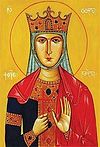
 Greatmartyr Ketevan the Queen of GeorgiaThe holy Queen Ketevan was the daughter of Ashotan Mukhran-Batoni, a prominent ruler from the Bagrationi royal family. |
 St John of PrislopSaint John was a monk of the Prislop Monastery in southwestern Romania at the turn of the sixteenth century. |