


| Previous day | 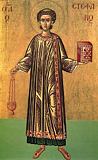
|
Next day |
| Old Style
September 15
|
Thursday |
New Style
September 28
|
| 17th Week after Pentecost. Tone 7. |  No fast.
|
 Afterfeast of the Exaltation of the Cross.
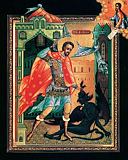
  Greatmartyr Nicetas the Goth (ca. 372).
Uncovering of the relics of St. Acacius the Confessor, bishop of Melitene in Pisidia (251). Martyrs Maximus, Theodotus, and Asclepiodota, of Adrianople (305-311). Martyr Porphyrius the Mime, of Caesarea (361). Uncovering of the relics of Protomartyr and Archdeacon Stephen (415). St. Joseph, abbot, of Alaverdi in Georgia (570). St. Philotheus the Presbyter, of Asia Minor (10th c.). St. Symeon, archbishop of Thessalonica (1430). St. Nicetas, disciple of St. Sergius of Radonezh and founder of the Theophany Monastery (Kostroma) (15th c.).
New Hiero-confessor Ignatius (Biryukov), archimandrite, of the Aleksievo-Akatov Monastery (Voronezh) (1932).
Sts. Bessarion I and Bessarion II, metropolitans of Larissa (1490-1540). St. Joseph the New, of Partos, metropolitan of Timisoara (Romania) (1656). St. Gerasimus, abbot, of Sourvia (ca. 1740). New Martyr John of Crete, at New Ephesus (1811).
Thoughts for Each Day of the Year
According to the Daily Church Readings from the Word of God
By St. Theophan the Recluse

Thursday. [Eph. 4:14-19; Mark 11:27-33]
The Saviour proves that He was sent from heaven using the testimony of John the Forerunner. They were silent, for there was nothing to say to the contrary, yet they did not believe. Another time He proved the same thing through His deeds, and they thought up a new twist: [He casteth out devils] by the prince of the devils (Mt. 9:34, Mk. 3:22). But when this twist was exposed to be completely inappropriate, they again were silent, but nevertheless did not believe. Thus unbelievers never believe no matter what you tell them and how convincingly you prove the truth. They cannot say anything to the contrary, while nevertheless they do not believe. One might say that their mind is paralyzed, since they reason sensibly about other things. Only when the issue touches upon faith do they become confused in their concepts and words. They also become confused when they present their outlooks as a substitute for the tenets of faith given by God. Here their doubt raises such a buttress that it is like a firm cliff. If you hear their entire theory through, you will see that a child could figure out that this is a spider’s web; but they do not see it. O unfathomable blindness! One can explain the obstinacy of unbelievers as their not wanting to believe, but where does this come from? Where does it get such power that it makes a sensible man consciously cling to an illogical form of thoughts? This is darkness. Is it not from the father of darkness?
Articles
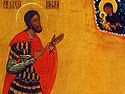 Greatmartyr Nicetas the GothThe Holy Great Martyr Nicetas was a Goth (a Germanic tribe). He was born and lived on the banks of the Danube River, and suffered for Christ in the year 372. |
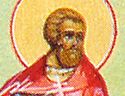 Martyr Porphyrius the ActorThe Holy Martyr Porphyrius suffered during the reign of Julian the Apostate (361-363). |
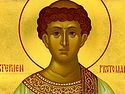 Protomartyr and Archdeacon StephenThe Holy Protomartyr and Archdeacon Stephen was the eldest of the seven deacons, appointed by the Apostles themselves, and therefore he is called “archdeacon.” |
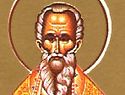 St. Philotheus the Presbyter in Asia MinorThe Holy Presbyter and Wonderworker Philotheus lived in the tenth century in the village of Mravin (or Myrmix) located in Bythnia in Asia Minor. |