


| Previous day | 
|
Next day |
| Old Style
March 20
|
Monday |
New Style
April 2
|
|
Passion Week.
Great Lent. |
 Monastic rule: xerophagy (bread, uncooked fruits and vegetables).
|
 The Holy Fathers who were slain at the Monastery of St. Sabbas: Sts. John, Sergius, Patrick, and others (796).
Martyrs Photina (Svetlana), the Samaritan woman; her sisters Phota, Photis, Parasceva, and Cyriaca; her sons Victor (or Photinus) and Joses; and Sebastian the Duke, the officer Anatolius, and Theoclitus, the former sorcerer—all martyred under Nero (ca. 66). Seven Virginmartyrs of Amisus (Samsun): Alexandra, Claudia, Euphrasia, Matrona, Juliana, Euphemia, and Theodosia (310). St. Nicetas the Confessor, bishop of Apollonias in Bithynia (9th c.). Suffering of St. Euphrosynus of Blue-Jay Lake (Novgorod) (1612).
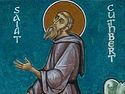
Righteous Abel, first martyr in the history of mankind. St. Martin of Braga in Iberia (580). St. Cuthbert of Lindisfarne, bishop (687). Hieromartyr Tadros, bishop of Edessa, at Jerusalem (691). Martyr Michael the Sabbaite, at Jerusalem (691). St. Wulfram, missionary (Neth.) (703). Martyr Archil II, king of Georgia (744). New Martyr Myron of Mega Castro on Crete (1793). New Hieromartyr Nicholas Holz, priest, of Novosiolki (Chelm and Podlasie, Poland) (1944).
Thoughts for Each Day of the Year
According to the Daily Church Readings from the Word of God
By St. Theophan the Recluse

Monday (Holy Week). [Matt. 24:3–35]
The Lord goes to a voluntary passion. We must accompany Him. This is the duty of anyone who confesses that by the power of Christ’s passion he has become who he is now, and of anyone who hopes to receive something which is so great and glorious, that it could not even enter one’s mind. How must one accompany Him? Through reflection and sympathy. Follow the suffering Lord in thought; and in your reflection extract such impressions as could strike your heart and bring it to feel the sufferings which were borne by the Lord. In order to better accomplish this, you must make yourself suffer through perceptible lessening of food and sleep, and an increase in the labour of standing and kneeling. Fulfil all that the Holy Church does, and you will be a good fellow-traveller of the Lord to His sufferings.
Articles
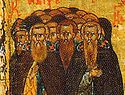 Martyred Holy Fathers who were slain at the Monastery of St SabbasSaints John, Sergius, Patrick and others were slain in the Monastery of Saint Sabbas. |
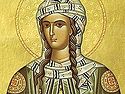
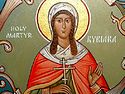 Martyr Kyriake of RomeSaint Kyriake was the sister of the Holy Martyr Photina (Svetlana) the Samaritan Woman, with whom the Savior conversed at Jacob’s Well (John. 4:5-42). |

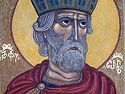 Martyr Archil II the King of GeorgiaThe Holy Martyr Archil II, King of Georgia belonged to the dynasty of the Chosroidoi, and he was a direct descendant of the holy emperor St Mirian (+ 342). |