| Previous day | 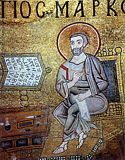
|
Next day |
| Old Style
April 25
|
Tuesday |
New Style
May 8
|
| 5th Week after Pascha. Tone 4. |  No fast.
|
 Holy Apostle and Evangelist Mark (63).
St. Sylvester, abbot, of Obnora Monastery (1379). St. Basil, elder, of Poiana Marului (1767).
St. Annianus, second bishop of Alexandria (86). Hieromartyr Stephen, patriarch of Antioch (479). St. Macedonius, patriarch of Constantinople (516). St. Bassian the Blind, hieroschemamonk of the Kiev Caves (1827).
Repose of Elder Philotheus (Zervakos) of Paros (1980).
Thoughts for Each Day of the Year
According to the Daily Church Readings from the Word of God
By St. Theophan the Recluse

Tuesday. [Acts 12:25–13:12; John 8:51–59]
The Jews became angry with the Lord because of His accusation, and picked up stones to cast at Him. But the Lord went through the midst of them, and so passed by (John 8:59). They did nothing to the Lord, but they destroyed themselves, for the consequence of their unbelief was the terrible sentence of the Lord: Behold, your house is left unto you desolate (Matt. 23:38) and also: let us pass from here. And the Lord passed to another place and chose other peoples for His habitation, instead of the beloved Israel. Even now, insignificant people, in the self-delusion of a proud mind which does not contain the truth of Christ, take up stones of opposition to the Lord and cast them at Him. They do not harm Him, because He nevertheless is the Lord, and His truth is the immutable truth; they only destroy themselves. The Lord goes by, leaving such people in their vain wisdom, which whirls them, like a whirlwind spins loose specks of dust. But when an entire nation is carried away with false wisdom, then the destiny of an entire nation is formed, as it was for the Jews. Understand, ye nations, and submit to the Lord!
Wednesday. [Gal. 3:15-22; Mark 6:7-13]
When the Lord sent the holy apostles to preach, He commanded that they not take anything with them but the clothes on their backs, sandals on their feet, and staff in hand. They were to have no cares about anything, entering in to this work as if everything were fully provided. Indeed, the apostles were completely provided for, without any external provisions. How was this arranged? Through their complete devotion to the will of God; that is why the Lord arranged for them not to have any need for anything. Their preaching moved the hearts of listeners, who fed and sheltered the preachers. But the apostles did not think of this and did not expect anything, committing all to the Lord. That is why they bore any unpleasantness they might have encountered patiently. Their only care was to preach, and their only sorrow was if people would not listen to their preaching. From this came the purity, independence and great fruitfulness of their preaching. The same is needed today as well, but our infirmity demands external provision, without which we will not take a step. This, however, is not a reproach against our apostles of today. In the beginning they definitely find comfort in being provided for, but then the thought of it disappears from their mind, and through their very labour they are raised up to the state of committing themselves to God. Very likely from that moment their preaching begins to be truly fruitful. Committing oneself to God is a very high degree of moral perfection, and people do not reach it immediately the moment they understand its value. It comes on its own after labors over oneself.
Articles
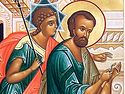 Apostle and Evangelist MarkThe Holy Apostle and Evangelist Mark, also known as John Mark (Acts 12:12), was one of the Seventy Apostles, and was also a nephew of Saint Barnabas (June 11). |