ORTHODOX CHRISTIANITY Orthodox Calendar
Orthodox Calendar 2021
Previous day
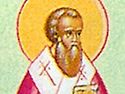
Святитель Феофилакт Никомидийский Чудотворная икона
Next day
Old Style
March 8
Sunday
New Style
March 21
First Sunday of Great Lent. Tone 8.
Great Lent.
Wine and oil allowed.

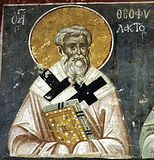
Cовершается служба, не отмеченная в Типиконе никаким знакомSt. Theophylactus, bishop of Nicomedia (842-845).

Apostle Hermas of the Seventy (1st c.). Hieromartyr Theodoretus, priest, of Antioch (361-363). Sts. Lazarus, founder (1391) and Athanasius, monk (15th c.), of Murmansk Monastery (Karelia). St. Andronicus (Lukash), schema-archimandrite of Tbilisi, Georgia, elder of Glinsk Monastery (1974).

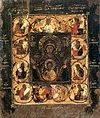
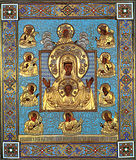
Kursk Root” Icon of the Sign of the Most Holy Theotokos (1898).

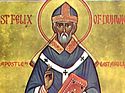
St. Felix of Burgundy, bishop of Dunwich and enlightener of East Anglia (ca. 648). Martyrs Quintilian and Capatolinus, at Nicomedia. St. Julian, archbishop of Toledo (690). St. Paul the Confessor, bishop of Plousias in Bithynia (ca. 840). St. Tarasius the Wonderworker, of Lycaonia.

Repose of Blessed Basiliscus of Uglich (1863) and Archbishop Vitaly (Maximenko) of Eastern America (1960).

Thoughts for Each Day of the Year
According to the Daily Church Readings from the Word of God
By St. Theophan the Recluse

St. Theophan the Recluse

The First Sunday of Lent. [Heb. 11:24–26, 32–12:2; John 1:43–51]

   The Sunday of Orthodoxy.[1] Do not forget the right word[2] which you spoke to God, renewing your testament with Him which you broke through your negligence. Remember how and why you broke it and try to avoid being unfaithful again. Pretty words are not glorious; faithfulness is glorious. Is it not glorious to have a testament with a king? How much more glorious is it to have a testament with the King of kings! But this glory becomes your disgrace if you are not faithful to this testament. How many great people have been glorified since the beginning of the world! And all of them have been glorified for their faithfulness, in which they stood firm, regardless of great misfortunes and sorrows as a result of this faithfulness. They had trial of cruel mockings and scourgings, yea, moreover of bonds and imprisonment: They were stoned, they were sawn asunder, were tempted, were slain with the sword: they wandered about in sheepskins and goatskins; being destitute, afflicted, tormented; Of whom the world was not worthy: they wandered in deserts, and in mountains, and in dens and caves of the earth…. Wherefore, seeing we are compassed about with so great a cloud of witnesses, let us run with patience the race that is set before us, looking unto Jesus the author and finisher of our faith (Heb. 11:36–38; 12:1–2).

[1] The first Sunday of Great Lent is called “The Sunday of Orthodoxy,” and celebrates the restoration of the veneration of Icons and the victory of Orthodoxy over the Iconoclast heresy.

[2] “The right word” is a reference to the meaning of the word “Orthodox” in Russian, which is literally “rightly glorifying.”

Articles
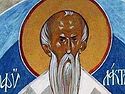
St. Theophylactus the Bishop of Nicomedia

Heading the Church of Nicomedia, Saint Theophylactus cared for the flock entrusted to him. He built churches, hospices, homes for wanderers, he generously distributed alms, was the guardian of orphans, widows and the sick, and personally attended those afflicted with leprosy, not hesitating to wash their wounds.

Apostle Hermas of the Seventy

The Holy Apostle Hermas of the Seventy was bishop at Philippopolis, and died a martyr in the first century.

Hieromartyr Theodoritus of Antioch

Saint Theodoritus was a presbyter and keeper of sacred vessels at the cathedral church in Antioch.

Venerable Lazarus of Murom

Saint Lazarus of Murom was a Greek, born at Constantinople. In his native city he became a monk at the High-Mount monastery under the Elder Athanasius Diskotes, builder of many monasteries.

Venerable Athanasius of Murom

Saint Athanasius was igumen at the monastery of Saint Lazarus during the mid-fifteenth century.

The Wonderworking Kursk Icon of the Mother of God "Of the Sign"

The frightened monastic brethren rushed immediately to the cathedral, where they beheld a scene of horrible devastation. The force of the blast had shattered the gilded canopy above the icon. The heavy marble base, constructed of several massive steps, had been jolted out of position and split into several pieces. A huge metal candlestick which stood before the icon and been blown to the opposite side of the cathedral. A door of cast iron located near the icon had been torn from its hinges and cast outside, where it smashed against a wall and caused a deep crack. All the windows in the cathedral and even those in the dome above were shattered. Amid the general devastation, the holy icon remained intact and even the glass within the frame remained whole. Thinking to destroy the icon, the anarchists had, on the contrary, become the cause of its greater glorification.

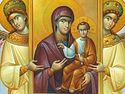
Icon of the Mother of God “Kursk-Root”

The Kursk Root Icon of the Mother of God “Of the Sign” is one of the most ancient icons of the Russian Church.

St. Felix of Burgundy the Bishop of Dunwich and Enlightener of East Anglia

Saint Felix, the Apostle of East Anglia, was born in the Burgundy region of what is now France. He was a bishop who was sent to England by Saint Honorius of Canterbury (September 30) to evangelize East Anglia.

From a Homily on the Sunday of the Triumph of Orthodoxy

St. Ignatius (Brianchaninov)

The word anathema means severance, rejection. When the Church anathematizes a teaching, it means that that teaching contains blasphemy against the Holy Spirit, and for the sake of salvation it should be rejected and removed, as poison is removed from food.

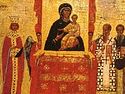
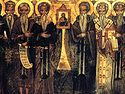
Commemoration of the Holy Fathers of the Seventh Ecumenical Council (787). The Holy Icons.

The Iconoclasts, by repudiating all representations of God, failed to take full account of the Incarnation. They fell, as so many puritans have done, into a kind of dualism. Regarding matter as a defilement, they wanted a religion freed from all contact with what is material; for they thought that what is spiritual must be non-material. But this is to betray the Incarnation, by allowing no place to Christ’s humanity, to His body; it is to forget that man’s body as well as his soul must be saved and transfigured.

The Triumph of Jesus Christ in the Triumph of Orthodoxy

Gabe Martini

But again, the celebration is about more than just the restoration and veneration of holy icons; it is a celebration of the victory of the Orthodox Faith itself. That is to say, it is a victory of both right-belief in (and right-worship of) our Lord and Savior Jesus Christ.

On the Sunday of Orthodoxy

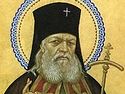
St. Luke, Archbishop of Crimea

Really, did the Lord Jesus Christ, who we glorify amd who we venerate in icons, not living among us? Did the Virgin Mary, who was painted by the apostle and evangelist Saint Luke not live among us? This icon was blessed by the very Theotokos herself, saying that grace would always be with this icon. Do you know how many miracles happen from icons of the Virgin Mary?

The First Sunday of Lent: The Sunday of Orthodoxy

The theme of the victory of the icons, by its emphasis on the incarnation, points us to the basic Christian truth that the one whose death and resurrection we celebrate at Easter was none other than the Word of God who became human in Jesus Christ.

Triumph of Orthodoxy Sunday

Fr. Thaddaeus Hardenbrook

After the exercise of Clean Week, the wisdom of the Church grants us a rest in the joy of Triumph of Orthodoxy Sunday.

Sunday of Orthodoxy

Archpriest Alexander Schmemann

Rejoicing today in the triumph of Orthodoxy on this first Sunday of Lent, we joyfully commemorate three events: one event belonging to the past; one event to the present; and one event which still belongs to the future.

No Graven Image: Icons and Their Proper Use

Fr. Jack N. Sparks, Ph.D.

The first time I invited a particular Protestant friend to step inside an Orthodox Church, he looked around very slowly, carefully, cau­tiously. “It’s pretty,” he said, “but doesn’t the Bible warn against graven images?”

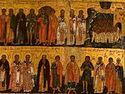
The Triumph of Orthodoxy and Holy Icons

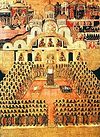
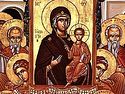
An icon celebrating the veneration of icons, the Triumph of Orthodoxy is the festal icon for the first Sunday of Great Lent. As Lent is a period of communal fasting which continues for seven weeks, such triumphalism early on is understandable: it helps to strengthen the faithful for the coming days.

The First Sunday of Great Lent: The Triumph of Orthodoxy

Fr. Sergei Sveshnikov

The iconoclast heresy rejected not only the icon as a window through which a ray of light may shine into the darkened human soul, but also the Orthodox teaching about Christ as fully God and fully human in the hypostasis of God the Son.

The Triumph of Orthodoxy: Why we kiss Pictures

A poster of the solar system on a kid's bedroom wall violates the commandment because it is an image of "heaven above." Jesus-fish stickers are also excluded because they depict something from "the water under the earth."
© ORTHODOX CHRISTIANITY