


| Previous day | 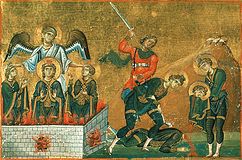
|
Next day |
| Old Style
December 17
|
Thursday |
New Style
December 30
|
|
28th Week after Pentecost.
Tone 2.
Nativity Fast. |
 Wine and oil allowed.
|
 Holy Prophet Daniel and the Three Holy Youths: Ananias, Azarias, and Misael (600 b.c.).
St. Daniel the Confessor (in schema Stephen), of Spain and Egypt (10th c.). St. Misael, hieromonk of Abalak Monastery (Irkutsk) (1852).
New Hieromartyr Sergius Florinsky, priest, of Rakvere, Estonia (1918).
Monk-martyrs Patermuthius and Coprius and Martyr Alexander the Soldier, of Egypt (361-363). The 47 Martyrs of Gaza at Heraclion (638). St. Sturm, abbot and founder of Fulda Monastery (Germany) (779). Sts. Athanasius, Nicholas, and Anthony, founders of Vatopedi Monastery, Mt. Athos (10th c.). New Martyr Nicetas of Nyssa (ca. 1300). St. Dionysius of Zakynthos, archbishop of Aegina (1622). New Hieromartyrs Paisius, abbot, of Trnava Monastery, Cacak (1814), and Abbacum, deacon (1815), at Belgrade.
Repose of Elder Hadji George of Mt. Athos (1886) and lay elder Panagis of Ilami, Cyprus (1989).
Thoughts for Each Day of the Year
According to the Daily Church Readings from the Word of God
By St. Theophan the Recluse

Thursday. [Heb. 10:35-11:7; Mark 9:10-16]
History flows on and, it seems, inexorably determines individual events. How many preparations there were to receive the Saviour!… At last His closest indicator came, John, but what came of it? With John, They have done…whatsoever they listed, and the Son of Man suffered and was humiliated. The flow of events could not be broken; it took its own. So the flow of history always draws everything after it. People ask, “Where is freedom? What is it, given such an order of events? No more than a phantom.” Thus fatalists usually reason. But this all-determining necessity for the flow of events is only an appearance; in reality all human events, both common and individual, are the fruit of man’s free undertakings. The common [history] flows exactly the way it does because everyone, or a majority of people, want this; and the individual enters into agreement with the common [majority] because one or another in particular wants it. The proof of this is obvious: in the midst of general good there occur bad particulars; and in the midst of general bad there occur good particulars. Also, in the midst of a firmly established commonality are born particulars which, spreading and becoming stronger and stronger, overpower the former commonality and take its place. But these particulars are always a matter of freedom. What in di Christianity have in common with the character of time in which it was conceived? It was sown by several individuals who were not a result of the necessary flow of history; it attracted those who desired it; it spread vigorously and became the general affair of mankind of the time, and yet it was a matter of freedom. Similarly, only in a bad direction—how did the West become corrupted? It corrupted itself: instead of learning from the Gospels they began to learn from pagans and adopt their customs—and they became corrupted. The same will happen with us: we have started to learn from the West which has fallen from Christ the Lord, and have transferred its spirit to ourselves. Finally, like the West, we will renounce true Christianity. But in all of this there is nothing necessarily determining the matter of freedom: if we want to, we will drive away the Western darkness. If we don’t want to, of course, we will submerge ourselves in it.
Articles
 Holy Youth AnaniasThe Holy Youth Ananias (“God is gracious”) was a companion of the Holy Prophet Daniel. |
 Holy Youth AzariasThe Holy Youth Azarias (“whom God helps”) was a companion of the Holy Prophet Daniel. |
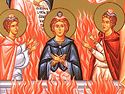 Holy Youth MisaelThe Holy Youth Misael (“Who is what God is?”) was a companion of the Holy Prophet Daniel. |
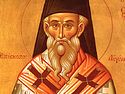 Venerable Dionysius of AeginaSaint Dionysius of Zakynthos, the Bishop of Aegina was born in 1547 on the island of Zakynthos. |