| Previous day | 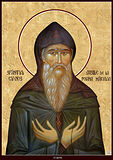
|
Next day |
| Old Style
April 25
|
Thursday |
New Style
May 8
|
| 3rd Week after Pascha. Tone 2. |  No fast.
|
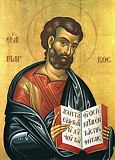
 Holy Apostle and Evangelist Mark (63).
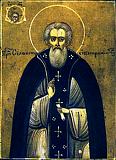
St. Sylvester, abbot, of Obnora Monastery (1379). St. Basil, elder, of Poiana Marului (1767).
New Hieromartyr Sergius Rokhletsov, archpriest, of Veliki Ustiug (1938).
St. Annianus, second bishop of Alexandria (86). Hieromartyr Stephen, patriarch of Antioch (479). St. Rusticus, archbishop of Lyon (501). St. Macedonius, patriarch of Constantinople (516). St. Bassian the Blind, hieroschemamonk of the Kiev Caves (1827).
Repose of Elder Philotheus (Zervakos) of Paros (1980).
Thoughts for Each Day of the Year
According to the Daily Church Readings from the Word of God
By St. Theophan the Recluse

039
Thursday. [Acts 8:26–39; John 6:40–44]
Saint Philip asks the eunich: understandest thou what thou readest? He answered: how can I, except some man should guide me? (Acts 8:31). How often those who read the word of God and writings of the fathers experience the same thing! What is read is beyond our comprehension; the mind cannot heed or grasp it, as if it were something foreign to it, about topics of an unknown realm. This is why an interpreter is needed, who is familiar with the meaning of the words. Saint Philip had the same spirit as the one which brought those prophecies, and so it was not difficult for him to interpret what the eunuch found hard to understand. Thus it is for us now: we must find a person who stands on such a level of life and knowledge as is touched upon by the scripture which is difficult for us, and he will interpret it without difficulty, because each level has its own spiritual view. He who stands on a lower level does not see all that he who stands on the higher sees, and can only guess about it. If it happens that the scriptures which are incomprehensible for us touch upon subjects of the higher level, but the interpreter met by us stands on the lower, then he cannot explain it as he should, and will apply everything to his own outlooks, and it will remain for us as dark as before. One must marvel at how people take on interpreting topics of Scripture while being totally foreign to the realm to which these subjects belong. And for them it does not come out as it should; nor do they fail to get puffed up over their own interpretations.
Wednesday. [Gal. 3:15-22; Mark 6:7-13]
When the Lord sent the holy apostles to preach, He commanded that they not take anything with them but the clothes on their backs, sandals on their feet, and staff in hand. They were to have no cares about anything, entering in to this work as if everything were fully provided. Indeed, the apostles were completely provided for, without any external provisions. How was this arranged? Through their complete devotion to the will of God; that is why the Lord arranged for them not to have any need for anything. Their preaching moved the hearts of listeners, who fed and sheltered the preachers. But the apostles did not think of this and did not expect anything, committing all to the Lord. That is why they bore any unpleasantness they might have encountered patiently. Their only care was to preach, and their only sorrow was if people would not listen to their preaching. From this came the purity, independence and great fruitfulness of their preaching. The same is needed today as well, but our infirmity demands external provision, without which we will not take a step. This, however, is not a reproach against our apostles of today. In the beginning they definitely find comfort in being provided for, but then the thought of it disappears from their mind, and through their very labour they are raised up to the state of committing themselves to God. Very likely from that moment their preaching begins to be truly fruitful. Committing oneself to God is a very high degree of moral perfection, and people do not reach it immediately the moment they understand its value. It comes on its own after labors over oneself.
Articles
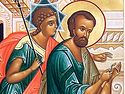 Apostle and Evangelist MarkThe Holy Apostle and Evangelist Mark, also known as John Mark (Acts 12:12), was one of the Seventy Apostles, and was also a nephew of Saint Barnabas (June 11). |