| Previous day | 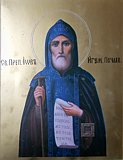
|
Next day |
| Old Style
May 6
|
Monday |
New Style
May 19
|
| 5th Week after Pascha. Tone 4. |  No fast.
|
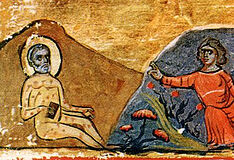
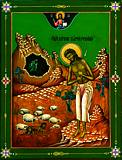
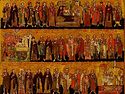
 Righteous Job the Long-suffering (ca. 2000-1500 b.c.).
Martyrs Barbarus the Soldier, Bacchus, Callimachus, and Dionysius, in Morea (ca. 362). Martyr Barbarus, a former robber, in Epirus (9th c.). St. Micah, disciple of St. Sergius of Radonezh (1385). St. Job, abbot and wonderworker of Pochaev (1651).
St. Edbert, bishop of Lindisfarne (698). Translation of the relics of St. Sava I of Serbia (1238). Venerable Sinaites of Serbia: Romilus of Ravanica, Romanus of Djunisa, Sisoes of Sinai and Sisojevac, Martyrius of Rukumije, Gregory of Gornjak, Zosimas of Tuman, and Gregory of Sinai (Mt. Athos) (14th c.). St. Seraphim of Mt. Dombos (1602). Translation of the relics of St. Pachomius of Nerekhta (1675). Martyrs Cyria, Caleria [Valeria], and Marcia, of Caesarea in Palestine (304).
Repose of Archbishop Theophylactus (Lopatinsky) of Tver and Kashin, theologian and defender of Orthodoxy (1741), and slaying of Priest John Karastamatis of Santa Cruz (1985).
Thoughts for Each Day of the Year
According to the Daily Church Readings from the Word of God
By St. Theophan the Recluse

Monday. [Acts 12:12–17; John 8:42–51]
What means, do you think, did the Lord use to explain to the Jews the reason for their not believing in Him? The means he used was to tell them the truth. And because I tell you the truth, ye believe me not (John 8:45). The lie became, as it is said, their flesh and blood, and made them unable to receive the truth. Why do people not believe today? For the same reason; the Lord speaks the truth; this is why they do not believe. But how can this be? Are they not all scientists, and don’t they talk only about the truth? They have many words, but no deeds. They spin their systems as a spider spins its web, only they don’t notice the flimsiness. The principles of their systems are groundless, and their conclusions cannot be proved; but they are satisfied with them nevertheless. There has become such a demand for hypotheses that it seems they alone make up the entire content of their minds, and this is reputed to be solid education. They apply the fog of their dreams to the few facts they have procured; and these facts appear in this fog totally different from what they are in reality. Nevertheless, this is all reputed to be the sphere of immutable truth. So their mind has gone rotten, and its taste has been ruined! How can it contain the truth? And so they do not believe the Lord, Who speaks only the truth.
Articles
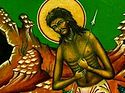 Martyr Barbarus in Thessaly, who was a robberThe Holy Martyr Barbarus, formerly a robber, lived in Greece and for a long time he committed robberies, extortions and murders. |
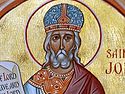
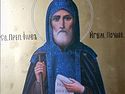 St. Job of Pochaev |