


| Previous day | 
|
Next day |
| Old Style
May 22
|
Wednesday |
New Style
June 4
|
|
7th Week after Pascha.
Tone 6.
Fast Day. |
 Fish, wine and oil allowed.
|
Afterfeast of the Ascension.  Martyr Basiliscus the Soldier, of Comana (308). St. John Vladimir, martyr and ruler of Serbia, whose relics are at Elbasan (1015). Blessed James of Borovichi (Novgorod) (ca. 1540).
Commemoration of the Second Ecumenical Council (381). St. Dodo of Gareji, Georgia (596).
New Hieromartyr Maxim (Zhizhilenko), bishop of Serpukhov (1931). New Hieromartyr Michael Borisov, archpriest, of Uglich (1942).
Righteous Melchizedek, king of Salem (ca. 2000 b.c.). Hieromartyrs Donatus, bishop of Thmuis, the priest Macarius, and the deacon Theodore (ca. 316). New Hieromartyr Zachariah, priest of Prusa (1802). New Monk-martyr Paul of Mt. Athos, at Tripolis, the Peloponnese (1818). Martyr Sophia the Healer.
Repose of Eldress Macrina of Volos (1995).
Thoughts for Each Day of the Year
According to the Daily Church Readings from the Word of God
By St. Theophan the Recluse

Wednesday. [Acts 23:1–11; John 16:15–23]
The Lord says to the holy apostles before His sufferings: A little while, and ye shall not see me: and again, a little while, and ye shall see me (John 16:16). The Lord’s sufferings and death so struck the holy apostles that the eyes of their mind became dim, and they no longer saw the Lord as the Lord The light was hidden, and they sat in a bitter and wearisome darkness. The light of Christ’s resurrection dispersed this darkness—and they again saw the Lord. Thus the Lord Himself explained His words: ye shall weep, He said, and lament, but the world shall rejoice; and ye shall be sorrowful, but your sorrow shall be turned into joy (John 16:20). It is said that every soul on the way to perfection experiences a similar defeat. Universal darkness covers it, and it does not know where to go; but the Lord comes, and changes its sorrow into joy. It is truly as necessary as it is for a woman to suffer before a man be born of her into the world. Can’t we conclude from this that he who has not experienced this has not yet given birth to a real Christian within himself?
Articles
 Martyrs Eutropius and Cleonicus of Amasea, and Basiliscus of ComanaThe Holy Martyrs Cleonicus, Eutropius and Basiliscus suffered in the city of Pontine Amasea (Asia Minor) in about the year 308. |
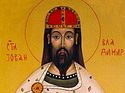 St. John-Vladimir the Prince of Bulgaria, the Greatmartyr and Miracle-workerThe Holy Martyr John-Vladimir, a Serbian prince, was born in the tenth century. |