| Previous day | 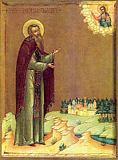
|
Next day |
| Old Style
June 12
|
Wednesday |
New Style
June 25
|
|
3rd Week after Pentecost.
Tone 1.
Fast of the Holy Apostles. |
 Monastic rule: xerophagy (bread, uncooked fruits and vegetables).
|
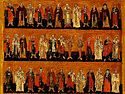
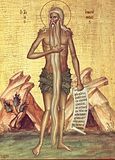
 St. Onuphrius the Great (4th c.).
  St. Peter of Mt. Athos (734).
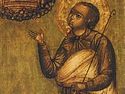
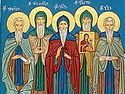
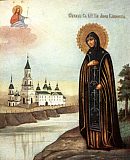
Sts. John, Andrew, Heraclemon, and Theophilus, hermits, of Egypt (4th c.). St. Arsenius, founder of Konevits Monastery (1447). St. Onuphrius, founder of Malsk Monastery (Pskov) (1492). Sts. Onuphrius and Auxentius, monks, of Vologda (15th c.-16th c). St. Stephen of Komel, founder of Ozersk Monastery (Vologda) (1542). Sts. Jonah and Bassian, monks, of Pertoma (Solovki) (1561). First (1650) and second (1909) glorifications of St. Anna, princess of Kashin (Euphrosyne in monasticism). St. Onuphrius, founder of Katrom Monastery (Vologda) (16th c). Uncovering of the relics of St. John of Moscow, fool-for-Christ (1672).
Miracle-working icons of the Theotokos and St. Onuphrius at St. Onuphrius Monastery (Poland). Valaam Icon of the Most Holy Theotokos.
St. Amphianus, bishop and confessor, in Cilicia (ca. 310). St. Olympius, bishop and confessor, in Thrace (4th c.). St. Timothy the Hermit, of Egypt (4th c.). Virgin-martyr Cunera of Rhenen (Neth.) (451). St. Julian of the Dagouta Church in Constantinople. St. John the Soldier, of Egypt (6th c.-7th c.). St. John (Tornicus) of Mt. Athos and Georgia (998). Synaxis of the Saints of St. Onuphrius Monastery at Jablechna (Poland). St. Triphyllius, bishop of Leucosia [Nicosia] on Cyprus (370). St. Nicephorus (Cantacuzene), archdeacon, of Constantinople, who suffered under the Uniates in Marienburg, Galicia (1599).
Repose of Elder Peter of Katounakia, Mt. Athos (1867), and Blessed Hermit Philaretus of Mt. Athos (1961).
Thoughts for Each Day of the Year
According to the Daily Church Readings from the Word of God
By St. Theophan the Recluse

Wednesday. [Rom. 8:2-13; Matt. 10:16-22]
He that endureth to the end shall be saved. And do we have anything to endure? In this nobody is lacking. Everyone’s arena of endurance is vast; therefore our salvation is at hand. Endure everything to the end and you will be saved. However, you must endure skillfully; otherwise you may not gain anything by your endurance. First of all, keep the holy faith and lead an irreproachable life according to faith; immediately cleanse every sin that occurs with repentance. Secondly, accept everything that you must endure as from the hands of God, remembering firmly that nothing happens without God’s will. Thirdly, give thanks sincerely to God for everything, believing that everything which proceeds from the Lord is sent by Him unto the good of our souls—thank Him for sorrows, and for consolations. Fourth, love sorrow for its great saving worth and cultivate your thirst for it, like a drink which although bitter, is healing. Fifth, keep in your thoughts that when a misfortune has come, you cannot throw it off like tight clothes; you must bear it. Whether in a Christian way, or in a non-Christian way, you must bear it nonetheless; so it is better to bear it in a Christian way. Complaining will not rescue you from misfortune, but only make it heavier; whereas humble submission to God’s Providence and good humour relieve the burden of misfortunes. Sixth, realize that you deserve even a greater misfortune—realize that if the Lord wanted to deal with you as you rightly deserve, would such a small misfortune really be enough? Seventh, most of all, pray, and the merciful Lord will give you strength of spirit. With such strength, others will marvel at your misfortunes which seem like nothing to you.
Articles
 Venerable John the Hermit of EgyptSaint John the Hermit lived in Egypt in the fourth century, and is mentioned in the Life of Saint Onuphrius. |
 Venerable Andrew the Hermit of EgyptSaint Andrew lived in Egypt in the fourth century, and is mentioned in the Life of Saint Onuphrius. |
 Venerable Heraclemon the Hermit of EgyptSaint Heraclemon lived in Egypt in the fourth century, and is mentioned in the Life of Saint Onuphrius. |
 Venerable Theophilus the Hermit of EgyptSaint Theophilus lived in Egypt in the fourth century, and is mentioned in the Life of Saint Onuphrius. |