


| Previous day | 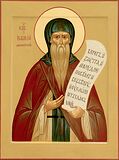
|
Next day |
| Old Style
August 3
|
Saturday |
New Style
August 16
|
|
10th Week after Pentecost.
Tone 8.
Успенский пост. |
 Wine and oil allowed.
|
 Sts. Isaac (383), and Dalmatus and Faustus (5th c.), ascetics of the Dalmatian Monastery, Constantinople.
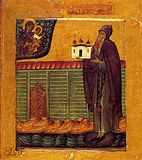
  St. Anthony the Roman, abbot (Novgorod) (1147).
Protomartyr Rajden of Tsromi and Nikozi, Georgia (457). St. Cosmas, eunuch and hermit, of Palestine (6th c.).
Holy Myrrh-bearer Salome (1st c.). St. John, confessor and abbot, of Patalaria Monastery (8th-9th c.). St. Theoclita the Wonderworker, of Optimaton (ca. 842). Nine Kherkheulidze brothers, their mother and sister, and 9,000 others, who suffered on the field of Marabda, Georgia (1625).
Repose of Hieroschemamonk Ignatius of Harbin (1958).
Thoughts for Each Day of the Year
According to the Daily Church Readings from the Word of God
By St. Theophan the Recluse

Saturday. [Rom. 15:30-33; Matt. 17:24-18:4]
The Lord paid the required church tribute and [kept] all other practices, both church and civic. He fulfilled this and taught the apostles to do the same, and the apostles in turn passed this same law on to all Christians. Only the spirit of life was made new; externally all remained as it had been, except what was clearly against the will of God—like, for instance, participating in idolatry, etc. Then Christianity gained the upper hand, displaced all former practices, and established its own. One could expect that it would thus be easier for the spirit of Christianity to develop and strengthen. So it was, but not for everyone. A large percent mastered external Christian practices but stopped there, not concerning themselves with the spirit of life. It is the same today. Out of the entire sum of Christians, who proves to be a Christian in spirit? What are the others? “They bear the name as if they are alive, but behold—they are dead.” When the apostles preached the Gospels, their word drew God’s portion out from the midst of the pagan world. Now through the same word the Lord chooses His portion from amidst the Christian world. “Whoso readeth, let him understand,” and let him take care to find out for certain whether he is in the portion of the Lord; and if he cannot be certain of this, let him take care to belong to the Lord, for in this alone lies salvation.
Articles
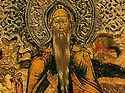 Venerable Isaac the Founder of the Dalmatian Monastery at ConstantinopleSaint Isaac lived during the fourth century, received monastic tonsure and pursued ascetic labors in the desert. |
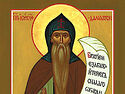
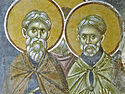 Venerable Dalmatus the Ascetic of the Dalmatian Monastery at ConstantinopleSaint Dalmatus excelled all the other monks in virtue. |
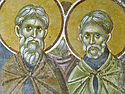 Venerable Faustus the Ascetic of the Dalmatian Monastery at ConstantinopleSaint Faustus and his father Dalmatus received the monastic tonsure from Saint Isaac at his monastery near Constantinople. |
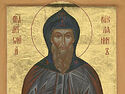 Venerable Anthony the Roman and Abbot of NovgorodSaint Anthony the Roman was born at Rome in 1067 to rich parents who adhered to the Orthodox Faith, and they raised him in piety. |
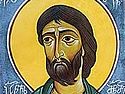
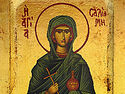 Holy Myrrhbearer SalomeShe was one of the women who followed Christ and ministered to Him from their own means, even until His Crucifixion and Burial. |