| Previous day | 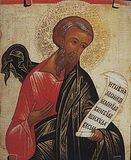
|
Next day |
| Old Style
August 14
|
Wednesday |
New Style
August 27
|
|
12th Week after Pentecost.
Tone 2.
Успенский пост. |
 Monastic rule: xerophagy (bread, uncooked fruits and vegetables).
|
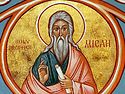
 Forefeast of the Dormition. Prophet Micah (8th c. b.c.).
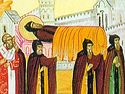
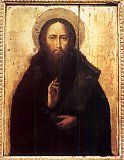
  Translation of the relics of St. Theodosius of the Kiev Caves (1091).
Hieromartyr Marcellus, bishop of Apamea (ca. 389). Translation of the relics of St. Arcadius, monk, of Novotorzhok (1798).
New Hieromartyr Basil (Bogoyavlensky), archbishop of Chernigov, and with him New Monk-martyr Matthew and New Martyr Alexis (1918). New Hiero-confessor Alexander (Urodov), archimandrite, of Sanaxar and Seven Lakes Monasteries (1961). New Hieromartyrs Nazarius, metropolitan of Kutaisi, Georgia, and with him priests Herman, Hierotheus, and Simon, and archdeacon Bessarion (1924). Synaxis of the New Martyrs of Georgia who suffered under the Atheist Yoke (20th c.). New Hieromartyrs Matthew (Pomerantsev), archimandrite, of Perm and Vladimir Tsedrinsky, archpriest, of Lepsinsk (Turkestan) (1918); and Eleutherius (Pechennikov), schema-archimandrite, of the Holy Trinity Monastery (Smolensk) (1937). New Martyr Eve (Pavlova), abbess of Holy Trinity Convent in Penza (Saratov) (1937).
Martyr Ursicius, at Illyricum (305-313). St. Fachanan, abbot, of Ross Carbery, Cork (ca. 600). New Martyr Symeon of Trebizond, at Constantinople (1653).
Commemoration of the disciples of St. Tikhon of Zadonsk: Monks Theophanes, Aaron, Nicander, Cosmas, and Metrophanes (18th-19th c.). Repose of Archimandrite Theodosius (Makkos) of Bethany (1991).
Thoughts for Each Day of the Year
According to the Daily Church Readings from the Word of God
By St. Theophan the Recluse

Thursday. [II Cor. 7:1-10; Mark 1:29-35]
In the morning, rising up a great while before day, He went out, and departed into a solitary place, and there prayed. Here is a lesson to get up early and devote the first hours of the day to prayer, in solitude. The soul, renewed with sleep, is fresh, light and capable of penetration, like fresh morning air; therefore it asks on its own to be allowed to go where all of its joy is found, to go before the face of the heavenly Father, to the company of the angels and saints. It is more convenient for the soul to pray at this time instead of later when the cares of the day already are piled upon the soul. The Lord orders everything. You must receive a blessing from Him for work, for needed understanding, and for crucial strengthening. And hurry as early as possible, before anything interferes, to lift yourself in solitude to the Lord in mind and heart, and to confess your needs and intentions to Him, and to beg for His help. Having disposed yourself with prayer and thoughts of God, from the first moments of the day, you will then conduct the whole day in reverence and fear of God, with collected thoughts. From this come discretion, steadiness, and harmony in deeds and mutual relations. This is a reward for the labour which you compel yourself to undertake in your morning solitude. Thus, even for worldly people this makes good sense, and is not something alien to their goals.
Wednesday. [II Cor. 6:11-16; Mark 1:23-28]
The demon praised the Saviour, but the Saviour said to him: Hold thy peace, and come out of him. Demons never say anything or do anything with a good purpose—they always have something evil in mind. So it was here. The Lord, not exposing their crafty designs, decided it with a word: hold thy peace and come out. He did not want to converse long with an evil spirit. Here is a lesson for us. A person manages to do very little of something good before a demon sits nearby and begins to trumpet in his ears: “You are this and that.” Do not listen and do not enter into conversation with this flatterer, but immediately say point blank: “Hold thy peace and come out,” and erase his tracks with sighs and self-reproach, then incense that place where he was with contrite prayer. He wants to give rise to self-opinion and self esteem, and to fan self-praise and vainglory from them—all of those thoughts and feelings are the spiritual life the same as thieves in everyday life. Like thieves that enter a house to rob its goods, so these demons, taking root in a soul, destroy all that is good in that soul and cast it away, so that nothing remains for the Lord to praise later.
Articles