| Previous day | 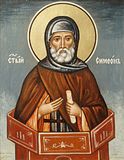

|
Next day |
| Old Style
September 1
|
Sunday |
New Style
September 14
|
| 14th Sunday after Pentecost. Tone 5. |  No fast.
|
 Church New Year
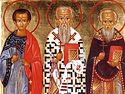
  St. Symeon Stylites (the Elder) (459) and his mother St. Martha (428).
Righteous Joshua the Son of Nun (ca. 1400 b.c.). Martyr Aeithalas of Persia (380). Holy 40 Women Martyrs: Laurencia (deaconess), Celsina, Theoclia, Theoctista, Dorothy, Eutychia, Thecla, Aristaineta, Philadelphia, Mary, Veronica, Euthymia, Lamprotatia, Euphymia, Theodora, Theodota, Teteia, Aquilina, Theodulia, Aplodora, Lampadia, Procopia, Paula, Junilla, Ampliana, Percissa, Polynicia, Maura, Gregoria, Cyria, Bassa, Callinica, Barbara, Cyriacia, Agathonica, Justa, Irene, Timothea, Tatiana, and Anna, and Hieromartyr Ammon (deacon), their teacher, at Heraclea in Thrace (321-323). Martyrs Callista and her brothers Evodus and Hermogenes, at Nicomedia (309). St. Dionysius Exiguus, monk, of Rome (ca. 545). St. Anthony (Abashidze), metropolitan of Tauride and Simferapol (1921).
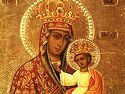
Synaxis of the Most Holy Theotokos in Miasena Monastery, in commemoration of the discovery of her icon (864). Icons of the Most Holy Theotokos: “Chernigov-Gethsemane,” (1869) “Of Alexandria,” “Avgustovskaya,” (1914) and “All-blessed One” (Kazan).
St. Verena of Zurzach (Switzerland) (ca. 350). Commemoration of the Great Fire at Constantinople (ca. 470). St. Giles (Aegidius), monastic founder, along the Rhone (ca. 712). St. Meletius the Younger, of Thebes (1095-1124). St. Nicholas of Courtaliatis on Crete, monk (1670). New Martyr Angelis of Constantinople (1680). St. Haido of Stanos (1820-1821). St. Symeon of Lesbos.
Repose of Hieromonk Sofian (Boghiu) of Romania (2002).
Thoughts for Each Day of the Year
According to the Daily Church Readings from the Word of God
By St. Theophan the Recluse

Fourteenth Sunday After Pentecost. [II Cor. 1:21-2:4; Matt. 22:1-14]
A king arranges a wedding for his son, he sends once for those who were bidden, sends twice, but because of earthly cares they do not come—one was busy at home, another with business. A new invitation was made in other spheres, and the wedding chamber was furnished with guests. Among them was found one not dressed for a wedding, who was therefore cast out. The meaning of this parable is clear: The wedding is the kingdom of heaven, the invitation is the preaching of the Gospels, those who refused are those who did not believe at all, and the one who was not dressed for a wedding believed, but did not live according to faith. Each of us must figure out for ourselves which category we belong to. That we are bidden is clear, but are we believers? Indeed it is possible to even be among believers, under their common name, and completely lack faith. One does not think at all about faith, as if it did not exist; another knows something or other about it and from it, and is satisfied; another interprets the faith in a distorted way; another relates to it with complete animosity. All are reckoned to be among the Christians, although they have absolutely nothing which is Christian. If you believe, figure out whether your feelings, or deeds conform to your faith—these are the garment of the soul, by which God sees you as dressed for the wedding or not. It is possible to know the faith well and be zealous for it, but in actual life to serve the passions, to dress, that is, in the shameful clothes of a sin-loving soul. Such people are one way in word, but are another way in the heart. On their tongue is, “Lord, Lord!” but within they are saying, “count me out.” (Examine yourself, whether you be in the faith and wearing the wedding clothes of the virtues, or wearing the shameful tatters of sins and passions.
Thursday. [Eph. 5:33-36; Luke 4:16-22]
The Lord did not only come to preach the acceptable year, but He brought it as well. Where is it? In the souls of believers. The earth will never become paradise under the current state of affairs; but it is and will be an arena of preparation for the heavenly life. The rudiments of heavenly life are placed in the soul, the possibility for it lies in God’s grace, while grace was brought by our Lord Jesus Christ—who brought, consequently, the acceptable year for souls. He who listens to the Lord and fulfils all that is commanded by Him, receives grace, and with its power enjoys the acceptable year within himself. This truly occurs in all who sincerely believe and act according to faith. You will not fill your soul with this acceptableness by thinking; you must act, and it will enter in on its own. There might not be any outer peace, just inner, and yet it cannot be separated from Christ. But it always happens that as soon as inner peace is established, outer disturbances are neither bitter nor heavy. Thus, this aspect is also acceptable—it only seem like a cold winter on the outside.
Articles

 Church New YearThe first day of the Church New Year is also called the beginning of the Indiction. The term Indiction comes from a Latin word meaning, “to impose.” |
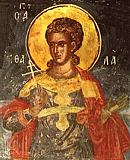
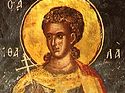 Martyr Aithalas of PersiaThe Holy Martyr Aithalas the Deacon, by order of the Persian emperor Sapor II, was put to death by stoning in the year 380 for confessing Christ. |