


| Previous day | 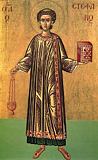
|
Next day |
| Old Style
September 15
|
Sunday |
New Style
September 28
|
| 16th Sunday after Pentecost. Sunday after the Exaltation of the Cross. Tone 7. |  No fast.
|
 Afterfeast of the Exaltation of the Cross.
  Greatmartyr Nicetas the Goth (ca. 372).
Uncovering of the relics of St. Acacius the Confessor, bishop of Melitene in Pisidia (251). Martyrs Maximus, Theodotus, and Asclepiodota, of Adrianople (305-311). Martyr Porphyrius the Mime, of Caesarea (361). Uncovering of the relics of Protomartyr and Archdeacon Stephen (415). St. Joseph, abbot, of Alaverdi in Georgia (570). St. Philotheus the Presbyter, of Asia Minor (10th c.). St. Symeon, archbishop of Thessalonica (1430). St. Nicetas, disciple of St. Sergius of Radonezh and founder of the Theophany Monastery (Kostroma) (15th c.).
New Hiero-confessor Ignatius (Biryukov), archimandrite, of the Aleksievo-Akatov Monastery (Voronezh) (1932).
Sts. Bessarion I and Bessarion II, metropolitans of Larissa (1490-1540). St. Joseph the New, of Partos, metropolitan of Timisoara (Romania) (1656). St. Gerasimus, abbot, of Sourvia (ca. 1740). New Martyr John of Crete, at New Ephesus (1811).
Thoughts for Each Day of the Year
According to the Daily Church Readings from the Word of God
By St. Theophan the Recluse

The Sixteenth Sunday After Pentecost. [II Cor. 6:1-10; Matt. 25:14-30]
The parable about the talents offers the thought that life is a time for trading. That means that it is necessary to hasten to use this time as a person would hurry to a market to bargain for what he can. Even if one has only brought bast shoes, or only bast,[1] he does not sit with his arms folded, but contrives to call over buyers to sell what he has and then buy for himself what he needs. No one who has received life from the Lord can say that he does not have a single talent—everyone has something, and not just one thing; everyone, therefore, has something with which to trade and make a profit. Do not look around and calculate what others have received, but take a good look at yourself and determine more precisely what lies in you and what you can gain for that which you have, and then act according to this plan without laziness. At the Judgment you will not be asked why you did not gain ten talents if you had only one, and you will not even be asked why you gained only one talent on your one, but you will be told that you gained a talent, half a talent or a tenth of its worth. And the reward will not be because you received the talents, but because you gained. There will be nothing with which to justify yourself—not with nobleness, nor poverty, nor lack of education. When this is not given, there will be no question about it. But you had hands and feet. You will be asked, what did you gain with them? You had a tongue, what did you gain with it? In this way will the inequalities of earthly states be levelled out at God’s judgment.
[1] Very inexpensive, unsophisticated items.
Articles
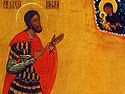 Greatmartyr Nicetas the GothThe Holy Great Martyr Nicetas was a Goth (a Germanic tribe). He was born and lived on the banks of the Danube River, and suffered for Christ in the year 372. |
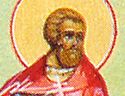 Martyr Porphyrius the ActorThe Holy Martyr Porphyrius suffered during the reign of Julian the Apostate (361-363). |
 Protomartyr and Archdeacon StephenThe Holy Protomartyr and Archdeacon Stephen was the eldest of the seven deacons, appointed by the Apostles themselves, and therefore he is called “archdeacon.” |
 St. Philotheus the Presbyter in Asia MinorThe Holy Presbyter and Wonderworker Philotheus lived in the tenth century in the village of Mravin (or Myrmix) located in Bythnia in Asia Minor. |