


| Previous day | 
|
Next day |
| Old Style
October 7
|
Monday |
New Style
October 20
|
| 20th Week after Pentecost. Tone 2. |  No fast.
|
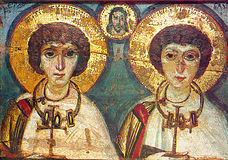
 Martyrs Sergius and Bacchus, in Syria (290-303). St. Jonah, bishop of Hankou, Manchuria (1925).
Hieromartyrs Julian, presbyter, Caesarius, deacon, Eusebius, presbyter, and Martyr Felix, at Terracina (268). Virgin-martyr Pelagia of Tarsus in Asia Minor (287). Hieromartyr Polychronius, priest, of Gamphanitus (4th c.). St. Sergius the Obedient, of the Kiev Caves (13th c.). St. Sergius, founder of Nurma Monastery (Vologda), disciple of St. Sergius of Radonezh (1412). Uncovering of the relics of St. Martinian, abbot, of Belozersk (White Lake) (1514).
New Hieromartyr Nicholas Kazansky, archpriest, of Simferopol (1942).
St. Mark, pope of Rome (336). St. Dubtach, bishop of Armagh (Ireland) (513). Martyr Osyth, princess of Chich (England) (ca. 700). St. Joseph, elder and wonderworker, of Khevi, Georgia (1763). St. John the Hermit and 98 Fathers, of Crete, St. Leontius the governor.
Repose of Archpriest Valentin Sventsitsky of Moscow (1931).
Thoughts for Each Day of the Year
According to the Daily Church Readings from the Word of God
By St. Theophan the Recluse

Monday. [Phil. 4:10-23; Luke 7:36-50]
How could it be that although Simon the Pharisee reveres the Lord and invites Him over, he is scandalized when he sees that He shows favour toward a sinful woman and permits her to approach Him? Why does he think to himself, “If He were a prophet,” and so forth? Because he had busied himself with the entertaining, and therefore ignored a sensible understanding of how God does things. These two realms, worldly and spiritual, are completely completely different characteristics and laws. Our mind all the while judges its own preoccupations according to the laws of those preoccupations. According to worldly thinking, one must not have contact with an obviously sinful woman. Simon judges thus, forgetting that repentance makes everyone pure and puts sinners on one level with the righteous. He thinks that the sinful woman should not be there, and that if the Saviour does not chase her away, it is probably because He does not know who she is. Another thought immediately follows this one: If He does not know that she is sinful, then what kind of prophet is He? He did not say this in words, but only thought it, although there was no change in his appearance outwardly. But the Lord saw his heart and corrected him accordingly. He suggested to him that sinners also have a place beside Him, and that the sinful woman who united with Him in her heart, revered Him more than did Simon, who honoured Him with nothing but food. Externals lead a person to a feeling of self-righteousness unpleasant to the Lord, while inner things always preserve a feeling of unworthiness before the face of the omniscient Lord.
Articles
 Martyr Polychronius the PresbyterThe Martyr Polychronius the Presbyter was the son of a landowner, raised with a love for work and in Christian piety |
 Venerable Sergius the Obedient of the Kiev Near CavesSaint Sergius the Obedient of the Kiev Caves, Near Caves, was a Greek who began his monastic life on Mount Athos. |
 99 Martyred Fathers of CreteThese 99 martyrs were from Crete. The most prominent among them was called John, and he was known as a wonderworker. |