


| Previous day | 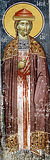
|
Next day |
| Old Style
November 27
|
Wednesday |
New Style
December 10
|
|
27th Week after Pentecost.
Tone 1.
Nativity Fast. |
 Wine and oil allowed.
|
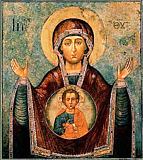
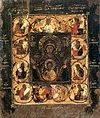
 Commemoration of the Miracle of the Weeping Icon of the Most Holy Theotokos “Of the Sign” at Novgorod (1170).
  Great-martyr James the Persian (421). St. Palladius of Thessalonica (6th c.-7th c.). Uncovering of the relics of St. Vsevolod (in baptism Gabriel), prince and wonderworker of Pskov (1192). St. James, bishop and wonderworker of Rostov (1392). St. Andrew Ogorodnikov, fool-for-Christ, of Simbirsk (1841). Synaxis of the New Martyrs and Confessors of Radonezh.
17 Monk-martyrs in India (4th c.). St. Romanus the Wonderworker, of Cilicia, near Antioch (5th c.). St. Diodorus, founder of Yeriegorsk Monastery (Solovki) (1633).
New Hieromartyrs Nicholas (Dobronravov), archbishop of Vladimir, Nikon (Belyaev), archimandrite, of the Staro-Golutvin Monastery (Kolomna), Ioasaph (Boyev), archimandrite, of Nikolskoye Monastery (Moscow), Nicholas (Saltykov), hieromonk of the St. Nicholas-Peshnosha Monastery (Moscow), and Apollos (Fedoseyev), hieromonk, of Moscow (1937). New Hieromartyr Cronides, archimandrite, and with him Seraphim (Krestianinov), abbot, and Xenophont (Bondarenko), hieromonk, all of St. Sergius Lavra (1937).
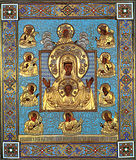
Icons of the Most Holy Theotokos “Of the Sign”: “Kursk Root” (1295) “Of Abalak” (1637), “Of Tsarskoe Selo,” and “Of Seraphimo-Ponetaev.” (1879)
St. Pinuphrius of Egypt (4th c.). St. Palladius, bishop of Elenopolis, author of The Lausaic History (ca. 430). St. Maximus of Riez (ca. 460). St. Nathaniel of Nitria (6th c.). St. Virgil, bishop of Salzburg, Irish missionary (784). St. Theodosius of Turnovo, monastic founder at Mt. Kelifarevo (1363).
Repose of Hieromonk Athanasius of Iveron, Mt. Athos (1973).
Thoughts for Each Day of the Year
According to the Daily Church Readings from the Word of God
By St. Theophan the Recluse

Wednesday. [II Tim. 4:9-22; Luke 20:1-8]
The priests, scribes and elders did not believe in the Lord. In order to raise them up to faith He offered them a question: the baptism of John, was it from heaven, or of men? Reason about this without bias and your reasoning will bring you to faith. What is said about John’s appearing can be said about every event accompanying the Lord’s coming in the flesh, and about His very coming, and all that comes into contact with it. Let each person reason about all of this—the conclusion will be the same: “truly this was the Son of God.” Various thoughts can come, confusion can arise, what seems like incongruities can be encountered; but at the end of all investigations one universal conviction will come: that it is impossible to think any other way than as is shown in the Gospels and apostolic writings. Great is the mystery of godliness: God is manifest in the flesh (I Tim. 3:16).This remains a mystery, but it will be clear to the mind according to the moral necessity which the mind’s own investigation will apply to itself—to confess this way, and in no other way. Unbelievers either do not investigate at all as they ought, or they investigate superficially, with a mind alien to it, or they accept a wretched frame of mind that is opposed to what faith would require. The most insignificant refutation of the faith is enough for them, in order to justify their unbelief. The words of unbelievers shake believers, because believers are satisfied with simple faith, and do not seek clarification of the foundations of faith. Those words take them unawares; that is why they are shaken.
Articles
 Greatmartyr James the Persian |
 Saint Romanus the WonderworkerSaint Romanus the Wonderworker was born in the city of Rosa and lived an ascetical life on the outskirts of Antioch, acquiring the gifts of clairvoyance and healing. |
 Icon of the Mother of God “Kursk-Root”The Kursk Root Icon of the Mother of God “Of the Sign” is one of the most ancient icons of the Russian Church. |
 Icon of the Mother of God “Seraphim-Ponetaevka”Six years after it was painted, the icon became known for its numerous miracles and became the chief holy item of the monastery. |