


| Previous day | 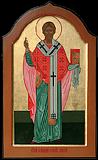
|
Next day |
| Old Style
December 4
|
Wednesday |
New Style
December 17
|
|
28th Week after Pentecost.
Tone 2.
Nativity Fast. |
 Monastic rule: cooked food, no oil.
|
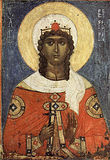
 Great-martyr Barbara and Martyr Juliana (306), at Heliopolis in Syria.
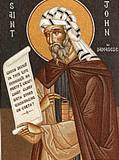
  St. John Damascene, monk of St. Sabbas Monastery (760).
St. John, bishop of Polybotum (716). St. Gennadius, archbishop of Novgorod (1504).
New Hieromartyrs John Pyankov and Alexis Saburov, archpriests, of Perm (1918). New Hieromartyr Dimitry Nevedomsky, archpriest, of Ryabovo (Tver) (1937).
New Hieromartyr Seraphim, archbishop of Phanarion and Neochorion (1601).
Thoughts for Each Day of the Year
According to the Daily Church Readings from the Word of God
By St. Theophan the Recluse

Saturday. [I Cor. 14:20-25; Matt. 25:1-13]
The parable of the ten virgins is read. Saint Macarius portrays the meaning of it thus: “The five wise virgins, in sobriety, hastening toward what was unusual to their nature, taking the oil in the vessel of their heart, that is the grace of the Spirit granted from above, could enter with the Bridegroom into the heavenly bridal chamber. The other foolish virgins, remaining in their own nature, did not become sober, did not try while they were still in the flesh to take in their vessels the oil of joy, but due to carelessness or self-conceit over their own righteousness, gave themselves over as if to sleep. Because of this they were not admitted into the bridal chamber of the kingdom, and were unable to please the heavenly Bridegroom. Restrained by earthly bonds and earthly so-called love, they did not dedicate all of their love and devotion to the heavenly Bridegroom, and did not bring oil. While the souls who have sought out the sacred gift of the Spirit unusual to their nature are attached to the Lord with all of their love, walk with Him, turn away from everything, concentrate their prayers and thoughts toward Him, and are made worthy to receive the oil of heavenly grace. The souls remaining in their nature creep with their thoughts along the earth, think about the earth, and their mind dwells on the earth. They think of themselves as belonging to the Bridegroom and are adorned with justifications of the flesh; but not having received the oil of joy, they have not been reborn through the Spirit from above (Discourse 4:6).”
Wednesday. [Heb. 5:11-6:8; Luke 21:5-7, 10-11, 20-24]
The disciples were remarking the Lord about the beauty of the temple building and its utensils, but He answered, The days will come, in which there shall not be left one stone upon another, that shall not be thrown down. This is a caption to go under all the beauty of this world. In appearance it seems durable and immortalized; but on the next day you look, and all will be as though it never was—the beauty withers, the strength is drained, the fame dwindles, minds are overcome, and clothes are worn out. Everything carries within itself a destroying power, which does not lie like an undeveloped seed, but is inherent unceasing activity, and everything flows to its own end. The fashion of this world passeth away (I Cor. 7:31) Surely man walketh about like a phantom… He layeth up treasure, and knoweth not for whom he shall gather it (Ps. 38:7–8). While we just keep rushing around vainly, are caught in cares, and there is no end to our cares. We encounter constant lessons around us, but we do everything our own way, as though we are blind and see nothing. And it is correct to say we are blind, or blinded; we do not await an end either to ourselves or to anything surrounding us or controlling us. And what else? Arranging our surroundings as we see fit, we are certain that we stand firmly, as on a rock, when actually it is more like we were standing in a bog, just about to sink down. But we do not feel this, and we give ourselves over to careless delight in passing things, as though they must always remain. Let us pray that the Lord open the eyes of our mind; and let us see everything not as it seems, but as it is.
Thursday. [Heb. 7:1-6; Luke 21:28-33]
And take heed to yourselves, lest at any time your hearts be weighed down with surfeiting, and drunkenness, and cares of this life, and so that day come upon you unawares. “That day,” which means the last day of the world or of each of us, comes like a thief and captures like a net; that is why the Lord says: Watch ye therefore and pray always (Luke 21:36). While since satiation and vain fussing are the top enemies of vigil and prayer, one is forewarned not to permit oneself to be weighed down by food, drink and worldly worries. For one who has eaten, drunk, made merry; who has slept enough but does it again what vigil can there be? Is one who is occupied solely with worldly things, day and night, up for prayer? “What should I do?” you say. “It is not possible to go without food; and we have to procure it. So we have to concern ourselves with this.” But the Lord did not say, “do not work, do not eat, do not drink,” but rather, let not your heart be weighed down with this. Work with your hands, but keep your heart free; if you must eat—eat, but do not burden yourself with food; drink wine when necessary, but do not let it lead to disturbance of your head and heart. Divide your outer from your inner and make the latter your life’s work, and the former a sideline; keep your attention and heart in the latter, and only your body, arms, legs and eyes in the former. Watch ye and pray always, that you may be made worthy to stand fearlessly before the Son of Man. In order to be made worthy of this, it is necessary to establish yourself before the Lord while you are still here in your life; there is one means for this—vigilant prayer in the heart performed by the mind. He who is in such a state of mind will not be taken unawares on “that day”.
Articles
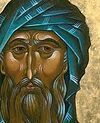
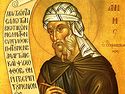 Saint John of DamascusSaint John of Damascus was born about the year 680 at Damascus, Syria into a Christian family. His father, Sergius Mansur, was a treasurer at the court of the Caliph. |
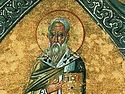 St. John the Bishop of PolybotumSaint John, Bishop of Polybotum (in Phrygia), was known as a denouncer of the heresy and impiety of Emperor Leo the Isaurian. |
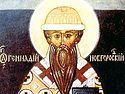 St. Gennadius the Archbishop of NovgorodThe time of holy Archbishop Gennadius as hierarch at Novgorod coincided with a terrible period in the history of the Russian Church. |