| Previous day | 
|
Next day |
| Old Style
December 27
|
Friday |
New Style
January 9
|
| 31st Week after Pentecost. Tone 5. |  No fast.
|
 Afterfeast of the Nativity of Christ.
  Protomartyr and Archdeacon Stephen (ca. 34). St. Theodore Graptus (“the Branded”), of Palestine and Bithynia, confessor (840).
St. Theodore, patriarch of Constantinople (686). Uncovering of the relics of St. Therapont, abbot, of Belozersk and Mozhaisk (1514). St. Boniface, founder of the St. Panteleimon Monastery (Kiev) (1871). St. Barlaam, metropolitan of Tobolsk and all Siberia (1802).
New Hieromartyrs Tikhon (Nikanorov), archbishop of Voronezh, and with him 160 martyred priests (1919).
St. Maximus, bishop of Alexandria (282). St. Luke, monk, of Tryglia. Martyrs Maurice and his son Photinus, with 70 soldiers, of Apamea (286-305).
Repose of Nicholas Ilminsky, missionary to the Tatars (1891), Archimandrite Agathangelus of Svir and Valaam (1909), Helen Ivanovna Motovilova (1910), Abbot Athanasius of Grigoriou, Mt. Athos (1953), and Archimandrite Seraphim (Rozenberg) of Pskov Caves Monastery (1993).
Thoughts for Each Day of the Year
According to the Daily Church Readings from the Word of God
By St. Theophan the Recluse

Thursday. [Eph. 4:14-19; Mark 11:27-33]
The Saviour proves that He was sent from heaven using the testimony of John the Forerunner. They were silent, for there was nothing to say to the contrary, yet they did not believe. Another time He proved the same thing through His deeds, and they thought up a new twist: [He casteth out devils] by the prince of the devils (Mt. 9:34, Mk. 3:22). But when this twist was exposed to be completely inappropriate, they again were silent, but nevertheless did not believe. Thus unbelievers never believe no matter what you tell them and how convincingly you prove the truth. They cannot say anything to the contrary, while nevertheless they do not believe. One might say that their mind is paralyzed, since they reason sensibly about other things. Only when the issue touches upon faith do they become confused in their concepts and words. They also become confused when they present their outlooks as a substitute for the tenets of faith given by God. Here their doubt raises such a buttress that it is like a firm cliff. If you hear their entire theory through, you will see that a child could figure out that this is a spider’s web; but they do not see it. O unfathomable blindness! One can explain the obstinacy of unbelievers as their not wanting to believe, but where does this come from? Where does it get such power that it makes a sensible man consciously cling to an illogical form of thoughts? This is darkness. Is it not from the father of darkness?
Friday. [Eph. 4:17-25; Mark 12:1-12]
In the parable about the vineyard is depicted the Old Testament Church and God’s care for it. The New Testament Church succeeded the Old, and so this parable can be applied to it as well. Since each Christian is also a living church of God, it can be applied to him as well. The latter is more needful for us. What is the vineyard? It is the soul that has received remission of sins, the grace of rebirth, the gift of the Holy Spirit as a promise of the heritage of the eternal kingdom, the word of God, the holy mysteries, a guardian angel. Who are the husbandmen? Consciousness and freedom. They receive the gifts and give a commitment to cultivate them and bear fruit to the Lord. Who are the careless husbandmen? Those who want to use the advantages of being a Christian as befits the external order of their lives, but do not bring worthy spiritual fruits to the Lord. Who are those sent from the Lord? The conscience and the fear of God, the word of God, teachers and pastors by whom the Lord wants to give understanding to the careless. Those who do not want to change themselves do not heed them; some drive them away and try to muffle their voice. Others even start to war against the Lord Himself, when they reject faith in Him in various forms. In the end, they will be miserably destroyed (cf. Mt. 21:41).
Articles
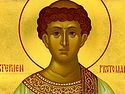 Protomartyr and Archdeacon StephenThe Holy Protomartyr and Archdeacon Stephen was the eldest of the seven deacons, appointed by the Apostles themselves, and therefore he is called “archdeacon.” |
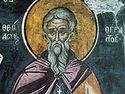 Venerable Theodore Graptus, “the branded,” ConfessorSaint Theodore the Confessor, and his brother Theophanes (October 11) were born in Jerusalem of Christian parents. |