ORTHODOX CHRISTIANITY Orthodox Calendar
Orthodox Calendar 2026
Previous day
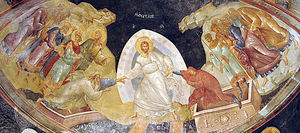
Воскресение Христово
Next day
Old Style
March 30
Sunday
New Style
April 12
No fast.

Совершается служба великому праздникуThe Bright Resurrection of Christ, The Passover (Pascha) of the Lord.

Cовершается служба, не отмеченная в Типиконе никаким знакомSt. John Climacus of Sinai, author of The Ladder (649). Cовершается служба, не отмеченная в Типиконе никаким знакомSt. Sophronius, bishop of Irkutsk (1771).

Prophet Joad, who dwelt in Bethel (10th c. b.c.). Holy Apostles Sosthenes, Apollos, Cephas, Caesar, and Epaphroditus, of the Seventy (1st c.). St. Eubula, mother of St. Panteleimon (ca. 303). St. John the Silent, of St. Sabbas Monastery (6th c.). St. Zosimas, bishop of Syracuse (ca. 662).

St. John the Hermit, of Cilicia (4th c.). St. John II, patriarch of Jerusalem (5th c.). St. Osburga of Coventry, virgin (ca. 1015). New Hieromartyr Zachariah, metropolitan of Corinth (1684). St. Gabriel, metropolitan of Kishinev and Khotin (Moldova) (1821).

Repose of Blessed Matrona (Mylnikova) the Barefoot, of St. Petersburg (1911).

Thoughts for Each Day of the Year
According to the Daily Church Readings from the Word of God
By St. Theophan the Recluse

St. Theophan the Recluse

The Bright Resurrection of Christ. [Acts 1:1–8; John 1:1–17]

   Pascha, the Lord’s Pascha! The Lord has led us from death to life by means of His resurrection. And this resurrection “the angels hymn in the heavens,” having seen the brightness of the deified human nature in the glory foreordained for it, in the countenance of the Lord and Redeemer. All Who truly believe in Him and cleave to Him with all their soul are changed into His image by the power of His resurrection. Glory, O Lord, to Thy most glorious resurrection! The angels hymn, rejoicing with us and foreseeing the filling of their assembly. Vouchsafe us also with pure heart, O Lord, to glorify Thee resurrected; seeing in Thy resurrection the severing of our consuming decay, the sowing of a most bright new life, and the dawn of future eternal glory, into which Thou hast gone before us by Thy Resurrection for our sake. The tongues not only of men but also of angels are have insufficient strength to express Thine unspeakable mercy toward us, O most gloriously resurrected Lord!

Articles

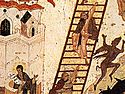
St. John of the Ladder (Climacus)

It is known from St. John's life that he ate what was allowed by the rule of fasting, but within measure. He did not go without sleep at night, although he never slept more than was needed to support his strength for ceaseless vigilance, and so as not to negatively affect his mind. "I did not fast beyond measure," he said of himself, "and I did not conduct intensified night vigil, nor did I sleep on the ground; but I humbled myself…, and the Lord speedily saved me.

Climacus

Archpriest Andrei Tkachev

The Ladder is not the Typikon; it has a different value. There are no prayer rules written there, no defined number of prostrations or amount of food to partake of. More important things are disclosed there, the effect of which is not revealed to the superficial gaze. In fact, the reading of such books is healing from blindness. And we ourselves, no matter how many years the Lord metes out to us, will never understand our inner life with such depth and clarity as did Abbot John of Mt. Sinai.

Translation of the relics of St Sophronius the Bishop of Irkutsk

Saint Sophronius, Bishop of Irkutsk and All Siberia, reposed on March 30, 1771, the second day of Holy Pascha. While they awaited a decision of the Holy Synod concerning the burial, his body remained unburied for six months, and during this time it was not subject to decay.

St. Sophronius the Bishop of Irkutsk

On the night after his monastic tonsure, Saint Sophronius heard a Voice in the Protection church predicting his future service: “When you become bishop, build a church dedicated to All Saints.”

St. Sophronius the Wonderworker, Bishop of Irkutsk and All Siberia

Holy Hierarch Sophrony recognized that his calling to Apostolic service in that land required more than education of the faithful Christians; it also meant that he had to bring to the Faith the idol worshipers, of whom there was a great number in Siberia.

Through His Prayers, the Frogs Don’t Croak

Irina Dmitrieva

Issues are resolved on site if you start asking St. Sophronius for help.

Prophet Joad

Holy Prophet Joad came from Samaria and prophesied during the tenth century before Christ (See 1/3 Kings 13).

Apostle Sosthenes of the Seventy

Saint Sosthenes was head of the Corinthian synagogue before his conversion.

Apostle Apollos of the Seventy

Saint Apollos assisted the Apostle Paul.

Apostle Cephas of the Seventy

According to Tradition, Saint Cephas was Bishop of Iconium.

Apostle Caesar of the Seventy

The Holy Apostles Sosthenes, Apollos, Cephas, Caesar and Epaphroditus of the Seventy:

Apostle Epaphroditus of the Seventy

Saint Epaphroditus was Bishop of Adrianium (Italy).

St. Euboula the Mother of St. Panteleimon

Saint Euboula, Mother of the Great Martyr Panteleimon (July 27), died peacefully around 303, before the martyrdom of her son.

Venerable John the Silent of St Sava’s Monastery

Saint John the Silent Bishop of the city of Colonia, was a model of a good Christian life for his flock.

St. Zosimus the Bishop of Syracuse

Saint Zosimus, Bishop of Syracuse, was born in answer to the fervent prayers of his parents, who were childless for a long time.
© ORTHODOX CHRISTIANITY