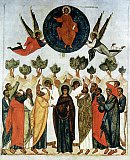
The Ascension of our Lord
 Apostle and Evangelist John the Theologian (98-117).
  St. Arsenius the Great, of Scetis (449-450).
St. Pimen the Faster, of the Far Caves in Kiev (12th c.). St. Arsenius the Lover of Labor, of the Kiev Caves (14th c.) Sts. Zosima and Adrian, of Volokolamsk, founders of the Sestrinsk Monastery (15th c.-16th c). Translation of the relics of St. Arsenius of Novgorod, fool-for-Christ (1785). Holy Georgian Martyrs of Persia (17th-18th c.).
St. Hierax of Egypt (5th c.). St. Iduberga, foundress of Nivelles (Neth.) (652). Sts. Wiro (710) and Plechelm (730), missionary bishops, and Otger, deacon (8th c.), in the Maas Valley at Limburg (Neth.). St. Macarius of Ghent, archbishop (1012). St. Emilia (375), mother of Sts. Macrina, Basil the Great, Naucratius, Peter of Sebaste, and Gregory of Nyssa. Commemoration of the healing of the blinded Stephen by the Icon of the Most Holy Theotokos of Cassiopia (1530).
Repose of Hieroschemamonk Michael of Valaam, confessor for the Orthodox Calendar (1934).
Thursday. Ascension. [Acts 1:1–12; Luke
24:36–53]
Saint Paul expresses the power of the
Lord’s Ascension in this manner: When he ascended
up on high, he led captivity captive, and gave gifts unto
men (Eph. 4:8). Having satisfied God’s
righteousness, the Lord opened for us all the treasures of
God’s goodness. This is indeed a capturing or taking
of spoils after victory. The beginning of the distribution
of these spoils to people is the descent of the Holy
Spirit, Who, having descended, always abides in the Church
and gives everyone that which he needs, receiving all from
that captive captivity (cf. Eph 4:8). Come everyone and
take. But prepare for yourself guardian of that treasure,
which is a pure heart; have hands to take it, which is
unreflecting faith. Then step forth searching hopefully,
and praying relentlessly.