


| Previous day | 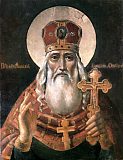
|
Next day |
| Old Style
May 13
|
Tuesday |
New Style
May 26
|
| 7th Week after Pascha. Tone 6. |  No fast.
|
Afterfeast of the Ascension.  Virgin-martyr Glyceria and her jailer Martyr Laodicius, at Heraclea (138).
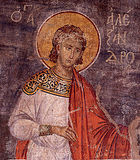
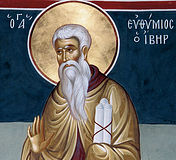
Martyr Alexander of Rome (ca. 284-305). St. Pausicacius, bishop of Synnada (ca. 606). Sts. George the Confessor, his wife Irene and children, of Constantinople (ca. 842). St. Euthymius the New (1028), founder of Iveron Monastery, and his fellow Georgian saints of Mt. Athos: his father John (998), his cousin George (1065), and Gabriel (10th c.). Righteous Virgin Glyceria of Novgorod (1522). Translation of the relics of Hieromartyr Macarius of Kanev, archimandrite, of Ovruch and Pinsk (1688). St. Macarius, abbot, of Glushitsa Monastery (Vologda) (1480).
New Hieromartyrs Basil Sokolov, Christopher Nadezhdin, and Alexander Zaozersky, archpriests, and Macarius (Telegin), hieromonk, and Martyr Sergius Tikhomirov, of Moscow (1922). Synaxis of the 103 New Martyrs of Cherkassy (20th c.).
St. Servatius, first bishop of Maastricht (384). St. Euthymius, patriarch of Jerusalem (1084). Commemoration of the monks of Iveron Monastery martyred by the Latins in the 13th century. St. Euphrosynus of Iveron (18th c.). St. Nicephorus, priest, of the monastery of Ephapsios.
Repose of Ryassaphore-monk John of St. Nilus of Sora Monastery (1863) and Eldress Sepfora of Klykovo (1997).
Thoughts for Each Day of the Year
According to the Daily Church Readings from the Word of God
By St. Theophan the Recluse

Tuesday. [Acts 21:26–32; John 16:2–13]
When he, the Spirit of truth, is come, he will guide you into all truth (John 16:13). Why is this source of knowledge not mentioned in books of rhetoric? It is not surprising that this point is not in pagan books of rhetoric, but why is it not in Christian ones? Can it be that when a Christian begins to philosophize he ought to cease being a Christian and forget all the true and unquestionable promises which were given to him? People often explain how to see and hear; they also teach well enough to make generalizations and inductions from what is seen and heard. But when the time comes to unravel the meaning of it all, here the nursling of logic is left to the devices of his own guesswork. Why not suggest to him: you have the revelations of the spirit of truth—follow them. They resolve the meaning of all existence and events in an indisputable manner, for they proceed from God, in Whom lies the source of existence itself. Perhaps all the guessing has multiplied so greatly that now all books (about God’s world) are filled with just guesses precisely because no one remembers to make that suggestion? It would be alright if these books were at least a little worthwhile; but it is clear at first glance that they are but the fruit of childish imagination.
Articles

 Martyr Alexander of RomeThe Holy Martyr Alexander suffered for Christ at the beginning of the fourth century. |
 St. Pausicacus the Bishop of SynnadaSaint Pausicacus, Bishop of Synnada, lived at the end of the sixth century in the Syrian city of Apamea. |
 St. George the Confessor, with his wife and children of ConstantinopleThe Holy Confessor George suffered for the veneration of holy icons at Constantinople in the first half of the ninth century. |

 Righteous Virgin Glyceria of NovgorodRighteous Virgin Glyceria of Novgorod, was the daughter of Panteleimon, a starosta of Legoscha Street in Novgorod. |
 Martyr Macarius the Archimandrite of Kanev and PereyaslavlThe Hieromartyr Macarius of Kanev lived in the seventeenth century. This was a most terrible time for Orthodox Christians in western Rus. |


