


| Previous day | 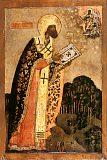
|
Next day |
| Old Style
June 8
|
Sunday |
New Style
June 21
|
|
3rd Sunday after Pentecost.
Tone 2.
Fast of the Holy Apostles. |
 Fish, wine and oil allowed.
|
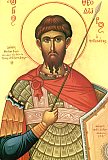
 Translation of the relics of Great-martyr Theodore Stratelates (“the General”), of Heraclea (319).
St. Ephraim, patriarch of Antioch (545). St. Zosimas, monk, of Phoenicia (Syria) (6th c.). St. Theodore, bishop of Rostov and Suzdal (ca. 1023). Uncovering of the relics of Sts. Basil and Constantine, princes of Yaroslavl (1501). Sunday of All Saints of Vologda. Sunday of All Saints of Novgorod. Sunday of All Saints of Pskov. Sunday of All Saints of St. Petersburg and Ladoga. Sunday of All Saints of Belorussia. Sunday of All Saints of Udmurtia.
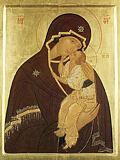
Yaroslavl Icon of the Most Holy Theotokos (13th c.). Valaam Icon of the Most Holy Theotokos.
Martyr Calliope, at Rome (ca. 250). Martyrs Nicander and Marcian, at Dorostolum in Moesia (303). St. Naucratius, brother of St. Basil the Great (4th c.). St. Melania the Elder, of Palladius’ Lausiac History (410). St. Atre (Athre) of Nitria (Egypt) (5th c.). St. Medardus, bishop of Noyon (Neth.) (560). St. Chlodulf (Cloud), bishop of Metz (696). St. Paul the Confessor, of Kaiuma Monastery in Constantinople (766). New Martyr Theophanes at Constantinople (1588). New Hieromartyr Theodore, priest, of Kvelta, Georgia (1609). Synaxis of the Church of the Cross at Mtskheta, Georgia. St. Nicephorus (Cantacuzene), archdeacon, of Constantinople, who suffered under the Uniates in Marienburg, Galicia (1599).
Repose of lay elder Theodore (Sokolov) of White Lake (1973).
Thoughts for Each Day of the Year
According to the Daily Church Readings from the Word of God
By St. Theophan the Recluse

Third Sunday After Pentacost. [Rom. 5:1-10; Matt. 6:22-33]
If therefore thine eye be single[1] thy whole body shall be full of light. But if thine eye be evil, thy whole body shall be full of darkness. Here the mind is called the eye, and the entire composition of the soul is called the body. Thus, when the mind is simple then it is light in the soul; when the mind is evil, then it is dark in the soul. What are a simple mind and an evil mind? A simple mind is one which accepts the word of God as is written, and is convinced beyond a doubt that all is indeed as is written. It has no deceit, no wavering, or hesitation. An evil mind is one which approaches the word of God with slyness, artful disputing, and questioning. It cannot directly believe, but subjects the word of God to its sophistry. It approaches the word not as a disciple, but as a judge and critic, to test something stated there, and then either scoffs at it, or says in a haughty manner, “Yes, not bad.” Such a mind has no firm tenets, because it clearly does not believe the word of God, and its own rationale is always unstable—today one way, tomorrow another. It has only wavering, confusion, questions without answers; everything is out of place with it, and it walks in the dark, fumbling its way. A simple mind sees everything clearly: every thing in it has a definite character, determined by the word of God. That is why every thing in it has its place, and it knows exactly how to behave with relation to things—it walks along open, visible roads, with complete assurance that they lead to the true goal.
[1] In Church Slavonic, the text translates as, If thine eye be pure.
Articles


 Right-believing Prince Basil of Yaroslavl |
 Right-believing Prince Constantine of YaroslavlIn their youth they lost their father, Vsevolod, who fell in battle with the Tatars (Mongols). St Basil, the elder brother, succeeded to the throne. |

