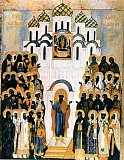
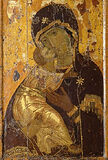
Meeting of the Vladimir Icon of the Most Holy Theotokos (1480).
  Martyr Agrippina of Rome and her companions Paula, Bassa, and Agathonica (253-259). Synaxis of the Saints of Vladimir.
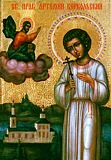
Martyrs Eustochius, Gaius, Proba, Lollia, and Urban, of Ancyra (4th c.). Second translation of the relics of St. Herman, archbishop of Kazan (1714). St. Artemius of Verkola (1545). Translation of the relics of St. Michael of Klops Monastery (Novgorod), fool-for-Christ (1482). St. Dionysius of Polotsk (1182). Sts. Vladimir and Agrippina, prince and princess of Rzhevsk (ca. 1226). Sts. Joseph, founder (1612), Anthony, and Ioannicius, abbots, of Zaonikiev Monastery, Vologda (17th c.).
New Hieromartyr Alexander Miropolsky, archpriest, of Kaslinsky Zavod (Ekaterinburg) (1918). New Hieromartyr Mitrophan (Krasnopolsky), archbishop of Astrakhan (1919).
Icons of the Most Holy Theotokos: “Umileniye” (“Of Tender Feeling”) of Pskov (1524), and “Zaonikiev.” (1588)
St. Etheldreda, foundress of Ely Monastery (England) (679). St. Nicetas of Thebes in Boetia and his disciples Theodore, Gregory, and Daniel (1079). Hieromartyrs Aristocleus, priest, Demetrian, deacon, and Athanasius, reader, at Salamis on Cyprus (306). Synaxis of the New Martyrs of Crete (1821-1822).
Repose of Schemamonk Zosimas of Solovki (1855) and Ivan M. Kontzevitch, spiritual writer (1965).
Monday. [Rom. 16:17-24; Matt. 13:10-23]
Why do many people not understand
discussions about spiritual things? It is due to a
thickening of their heart. When their heart is full of
attachments to earthly things, it grows coarse, as is
said, he grew fat, he grew thick, he waxed broad
[Deut. 32:15]. In this state it gravitates downward like a
heavy-weight, dragging and chaining the entire soul to the
ground, together with the mind. Then, always churning in
its circle of low objects, it becomes low in its thought
and cannot soar up on high, like a bird weighed down with
food. Churning there, it does not see the heavenly, and
its entire disposition is against it… Heaven is an
alien country to these people. Such a person has nothing
within the sum total of his understanding and experience
to which he could relate the heavenly, that he might be
able to see it if only through a glass darkly [cf. Cor.
13:12]. That is why he won’t try to discuss it, nor
does he wish to listen to others discussing it, and he
won’t pick up any books written about it.
Isn’t this why you’ll often find any number of
secular magazines in people’s homes, but not a
single spiritual periodical or book—not even the
Gospels?
Tuesday. [I Cor. 1:1-9; Matt. 13:24-30]
The good seed was sown, but the enemy
came and sowed tares among the wheat. The tares in the
Church are heresies and schisms, and in each of us they
are bad thoughts, feelings, desires, and passions. A
person accepts the good seed of the word of God, decides
to live in a holy way, and begins to live in this way.
When such a person falls asleep, that is, when his
attention toward himself weakens, then the enemy of
salvation comes and places evil ideas in him, which if not
rejected at the start ripen into desires and dispositions,
introducing their own spheres of activity, which mix
themselves in with good deeds, feelings and thoughts. Both
remain together this way until the harvest. This harvest
is repentance. The Lord sends the angels—a feeling
of contrition and the fear of God, and they come in like a
sickle, then burn up all the tares in a fire of painful
self-condemnation. Pure wheat remains in the grain-house
of the heart, to the joy of the man, the angels, and the
most Good God worshipped in the Trinity.