


| Previous day | 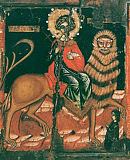
|
Next day |
| Old Style
September 2
|
Tuesday |
New Style
September 15
|
| 16th Week after Pentecost. Tone 6. |  No fast.
|
 Martyrs Mamas of Caesarea in Cappadocia, and his parents, Theodotus and Rufina (3rd c.) St. John the Faster, patriarch of Constantinople (595).
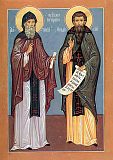
  Sts. Anthony (1073) and Theodosius (1074), of the Kiev Caves.
3,628 Martyrs at Nicomedia (303-305). Synaxis of the Saints of Saratov.
New Hieromartyrs Barsanuphius (Lebedev), bishop of Kyrillov, and priest John Ivanov, and Martyrs Seraphima (Sulimova), abbess of the Therapontov Convent, and Anatole, Nicholas, Michael, and Philip, all at the St. Cyril of White Lake Monastery (1918). New Hieromartyr Damascene (Tsedrik), bishop of Starodub. New Hieromartyr Euthymius Goryachev, Presbyter (1937). New Hieromartyrs Herman (Ryashentsev), bishop of Vyaznikov, and the priest Stephen Yaroshevich (1937).
“Kaluga” Icon of the Most Holy Theotokos (1748).
Righteous Eleazar, son of Righteous Aaron, and Righteous Phineas (ca. 1400 b.c.). St. Hieu, abbess of Tadcaster (England) (ca. 657).
Repose of Archbishop Vladimir of Kazan (1897).
Thoughts for Each Day of the Year
According to the Daily Church Readings from the Word of God
By St. Theophan the Recluse

Monday. [Gal. 4:28-5:10; Mark 6:54-7:8]
The Lord rebukes the Pharisees not for their external routines and rules of conduct, but for partiality toward them—for limiting themselves to external worship of God, with no concern for what was in the heart. It is impossible to be without externals. The highest internal things require the external as their expression and garment. In reality, internal things are never alone, but are always united with the outer; only in false theories are they separated. But again it is obvious that externals alone are nothing; their worth comes from the presence of the internal things contained in them. Thus, once the internal ceases to be, the external might as well not be there. Meanwhile, we have a weakness for outward appearances in which the internal is depicted and takes definite form, to such an extent that we are satisfied with fulfilling them alone, without even thinking that there might be internal things. And since the internal is harder to attain than the external, it is quite natural to get stuck on the latter, not striving for the former. What can we do? We must govern ourselves and keep the internal things in mind, always pushing ourselves toward them through the externals, only considering a work to be real when the internal and external are united in it. There is no other way. Attentiveness toward oneself, soberness, and vigilance are the only levers for raising up our nature which is fat and has a penchant for lowly things. Notice that those who possess the internal never abandon the external, though they consider it to be of no particular value.
Tuesday. [Gal. 5:11-21; Mark 7:5-16]
There is nothing from without a man, that entering into him can defile him: but the things which come out of him, those are they that defile the man. This and similar passages, for example: But meat commendeth us not to God (1 Cor. 8:8) are usually cited by those who do not like to fast, supposing that they thereby sufficiently justify their not fasting according to the rule and custom of the Church. The validity of this excuse is known to everyone faithful to the Church. The fast decrees that we abstain from some foods not because they are defiled, but because we can more conveniently refine our flesh by this abstinence—something crucial for inner progress. This meaning of the law of fasting is so essential that those who consider some foods to be defiled are numbered among the heretics. Those who do not like to fast would do better not dwell on this point, but on the point that fasting is not obligatory, although it definitely is a means for overcoming sinful urges and the strivings of the flesh. But they can in no way stand their ground on this point, either. If inner progress is obligatory, then the means by which it is obtained is also obligatory, namely, fasting. Each person’s conscience says this to him. In order to soothe their conscience, they assert: I will compensate for my omission of fasting in another way; or, fasting is harmful for me; or, I will fast when I want to, and not during the established fasts. However, the first excuse is inappropriate because nobody has yet managed without fasting to cope with his flesh, or order his inner life properly. The last excuse is also inappropriate, because the Church is one body, and to separate oneself from others in it means opposing its construction. One can remove oneself from the general customs of the Church only by leaving it; but while someone is a member of it, he cannot say this and demand that. The second excuse has a shadow of a right. Indeed, among the limitations of fasting the obligation is lifted from those for whom fasting acts destructively, because the fast was established not to kill the body, but to mortify the passions. But if one should conscientiously count the true number of such people it would be seen that they are so few that they do not even count. Only one real reason remains—lack of desire. There is no point in debating with this. You will neither be brought to heaven against your will; only when you are condemned to hell you will go whether you want to or not—they will grab you and fling you there.
Articles
 Martyr Mamas of Caesarea in CappadociaThe Holy Great Martyr Mamas was born in Paphlagonia, Asia Minor in the third century of pious and illustrious parents, the Christians Theodotus and Rufina. |


 The New Martyrs of SeptemberRosamaria MendesThe Bolsheviks made no secret of their crime: they handed over the pectoral cross taken from the slain hieromonk to the monastery abbot. |