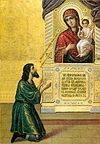
According to the Law of Moses, all Hebrew parents must bring their first born son on the fortieth day after birth to the Temple to be consecrated to God. It was the custom to bring a sacrifice in thanksgiving to God. The law was established in remembrance of the exodus of the Hebrews from Egypt — freedom from slavery — when the first-born Hebrews were spared from death. In fulfilment of this law, the Mother of God with Joseph brought the infant Jesus to the Temple in Jerusalem and brought for the sacrifice two fledgling doves.
Archpriest Valentin Amphiteatrov
The time of Great Lent is becoming shorter for Christians day by day. Day follows day, bringing us ever closer to the festive weeks of Christ’s Resurrection. The joy of anticipation kindles our feelings, while at the same time, sadness engulfs our soul as the conscience informs the heart that we have not spent the time of the fast as befits a true Christian.
Hieromonk Job (Gumerov)
Rating: 9,2|Votes: 11
The Saturdays of commemorations of the dead are called ancestral Saturdays (the first universal commemoration on Meat Fare Saturday, the second, third, and fourth Saturdays of Great Lent, Trinity Saturday, and St. Demetrius Saturday). Why do these take place specifically on Saturdays? What are the historical roots of this tradition? They were not all instituted at the same time.
Rating: 6,7|Votes: 21
Since throughout the Great Fast such commemorations as are performed at every other time during the year do not occur during the celebration of the Presanctified Liturgy, it is the accepted practice in our Orthodox Church to commemorate the departed on these three Saturdays, that the dead be not deprived of the Church's saving intercession. (The remaining Saturdays of the Great Fast are consecrated to special celebrations: Saturday of the first week to St. Theodore the Recruit; Saturday of the fifth week to the praise of the Theotokos; the sixth Saturday commemorates the resurrection of the Righteous Lazarus.)
Metropolitan Hilarion (Kapral), Oleg Petrov
Rating: 1|Votes: 1
We now have the fullness of joint celebration of divine services, in communion with the hierarchy of the Local Russian Church, with the clergymen who visit various countries. When we bishops, clergymen and laity, come to Russia or travel to other countries, we can participate in the fullness of ecclesial communion, visit the great monasteries, the holy sites of the Russian Orthodox Church. This gives us spiritual strength in our efforts abroad: educating people, providing spiritual nourishment and furthering the Orthodox mission.