Abba Dorotheos
Rating: 10|Votes: 1
The Fathers have said that it is not characteristic of monks to become angry or to offend anyone, and furthermore, "He who has overcome anger has overcome the demons, but he who is overcome by this passion is a stranger to the monastic life." And what should we say of ourselves when we not only do not leave off irritability and anger, but also surrender ourselves to the remembrance of wrongs? What must we do but weep over such a pitiful and inhuman state of our souls? And so let us pay heed to ourselves O brethren, and let us strive with God's help to be delivered from this ruinous passion.
Rating: 8|Votes: 6
So what is it we want from our neighbor? Why are we so concerned about the burden of others? We have plenty to be concerned about, brothers! Let each one of us attend to himself and his own sins. God alone has the authority to judge, to justify or to condemn, inasmuch as He knows the state of each one of us and our upbringing and our gifts, our constitution and abilities, and it is for him to judge each of these things according to the knowledge that He alone has. For God judges the affairs of a bishop in one way and those of a secular governor in another.
Archimandrite Tikhon (Shevkunov)
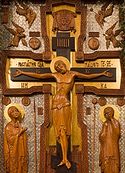
“The Cross is the guardian of the whole world; the Cross is the beauty of the Church, the Cross is the might of kings; the Cross is the confirmation of the faithful, the Cross is the glory of angels and the wounding of demons.” The Church’s beauty lies in fulfilling the commandments and in being faithful to God.
Rating: 9|Votes: 1
The wise Solomon says in the Proverbs (Prov. 11:14), They that have no guidance fall like leaves, but in much counsel there is safety. Do you see O brethren, the power of this expression? Do you see what the Holy Scriptures teaches us? It exhorts us not to trust in ourselves, not to consider ourselves intelligent, not to believe that we are able to govern ourselves; for we have need of help, we have need of those who instruct us according to God. There are no people more unfortunate and closer to perdition than those who do not have an instructor in God's path.
Rating: 1|Votes: 1
St. John says in his Catholic epistle (I John 4:18) Perfect love casteth out fear. What does the Holy Apostle wish to say to us through this? What kind of love is he talking about, and what kind of fear? The Prophet David says in the Psalms (Ps. 33:10) Fear ye the Lord all ye His saints, and we find many other similar expressions in the Divine Scriptures. Thus, if even saints, who so loved the Lord, feared Him, then how is it, as St. John says, that Perfect love casteth out fear?