ORTHODOX CHRISTIANITY Orthodox Calendar
Orthodox Calendar 2025
Previous day
Святитель Варсонофий Тверской Святой прп. Павел Препростый Святой Стефан Щилянович
Next day
Old Style
October 4
Friday
New Style
October 17
19th Week after Pentecost. Tone 1.
Fast Day.
Wine and oil allowed.

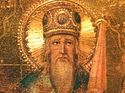
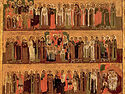
Cовершается служба, не отмеченная в Типиконе никаким знакомHieromartyr Hierotheus, bishop of Athens (1st c.). Совершается служба со славословиемUncovering of the relics (1595) of St. Gurias, first archbishop of Kazan, and St. Barsanuphius, bishop of Tver (1595). Cовершается служба, не отмеченная в Типиконе никаким знакомSynaxis of the Saints of Kazan.

Martyrs Gaius, Faustus, Eusebius, and Chaeremon, of Alexandria (3rd c.). Hieromartyr Peter of Capitolia, bishop of Bostra in Arabia (715). Martyrs Domnina and her daughters Berenice (Bernice) and Prosdoce, of Syria (302). Martyr Adauctus (ca. 312) and his daughter St. Callisthene (ca. 318), of Ephesus. Sts. Paul the Simple (ca. 339) and Ammon (350), of Egypt, disciples of St. Anthony the Great. St. Vladimir Yaroslavich, prince of Novgorod (1052), and his mother St. Anna of Novgorod (1050). Sts. Helladius and Onesimus of the Near Caves in Kiev (12th c.-13th c.). St. Ammon, recluse, of the Far Caves in Kiev (13th c.). St. Stephen Stiljanovic, despot of Srem, Serbia (1540) and his wife St. Helen (Elizabeth in monasticism) (ca. 1543). Sts. Jonah and Nectarius, monks, of Kazan (16th c.).

New Hieromartyrs Basil (Tsvetkov), archimandrite, of Stary Kelets (Ryazan) and Tikhon Arkhangelsky, archpriest, of Kuiman (Voronezh) (1937). New Hiero-confessor Barsanuphius (Yurchenko) of Kherson (1954).

St. Theodore the Wonderworker, bishop of Tamassos, Cyprus (2nd c.). St. John (Lampadistes) of Cyprus (10th c.). Hieromartyr Evdemoz, catholicos of Georgia (1642).

Thoughts for Each Day of the Year
According to the Daily Church Readings from the Word of God
By St. Theophan the Recluse

St. Theophan the Recluse

Friday. [Phil. 3:8-19; Luke 7:31-35]

   Whereunto then shall I liken the men of this generation? That is, unbelievers. If the Lord poses this question as if in perplexity, is it not even more proper for us to be perplexed by acts of unbelief? One might ask: how can people go against something that is obvious in every respect? And yet they do. The fact that Satan resists is not surprising—such is his name: the enemy of truth and goodness. He clearly sees that God exists, that God will judge him and condemn him, that death for him is already prepared, but is nevertheless defiant, and not for the sake of anything but evil, and consequently, for greater ruin to himself. Are not unbelievers being controlled by this spirit of fighting against God? At least according to the understanding we have about the soul and its operations, unbelief, given the obviousness of the foundations of faith, is as inexplicable as a sinner’s slavery to sin after he has clearly seen that sin is destroying him. And here is another contradiction! Only unbelievers and lovers of the passions deny the existence of Satan and unclean spirits. Those who should have stood up for them most of all totally renounce them. Does not this teaching come from them? Those who are of the darkness love the darkness, they teach people to say that they do not exist, and that moral life takes shape by itself, without their snares and deceit.

Articles

Hieromartyr Hierotheus the Bishop of Athens

The saint was consecrated by the Apostle Paul to the rank of bishop.

St. Gurias the Archbishop of Kazan

In 1561 the saint fell grievously ill and could no longer perform the divine services himself. On feastdays they carried him into the church, and he either sat or lay down, since he did not have the strength to walk or even stand.

And Their Coffins Were Not Destroyed

Nun Natalia (Kaverzneva)

St. Gurius’s coffin was filled with fragrant myrrh resembling pure water; moreover the saint’s relics were afloat at the surface of this liquid.

St. Barsanuphius the Bishop of Tver

While still a youth, he was captured by the Crimean Tatars. Accepting this as the Lord’s will, he meekly submitted to his masters, and dutifully accomplished the work they assigned him to do.

Martyrs Gaius, Faustus, Eusebius, and Chaeremon, of Alexandria

Saints Gaius, Faustus, Eusebius, and Chaeremon were deacons and disciples of Saint Dionysius of Alexandria.

Martyr Peter of Capetolis

Saint Peter was born in Capitolis in Palestine, and was the father of three children.

Martyr Domnina with her daughters of Syria

Saint Domnina was a woman with two daughters named Verine and Prosdoce. Leaving their home and family, they settled in Edessa on the plain of Mesopotamia.

Martyr Callisthene and her father Audactus of Ephesus

The holy martyr Callisthene was born in Ephesus, and her father was the eparch Audactus.

Venerable Paul the Simple and Disciple of the Venerable Anthony the Great

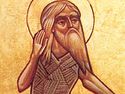
Saint Paul the Simple of Egypt also lived in the fourth century and was called the Simple for his simplicity of heart and gentleness. He had been married, but when he discovered his wife’s infidelity, he left her and went into the desert to Saint Anthony the Great.

Venerable Ammon

Saint Ammon of Egypt was raised in Christian piety. He entered into marriage at the urging of his parents, but by agreement with his spouse preserved his virginity and they lived as brother and sister.

Right-believing Prince Vladimir Yaroslavich the Prince of Novgorod

The holy prince died at age thirty-two on October 4, 1052, twenty days after the consecration of the Sophia cathedral, and his relics were placed in the church he built.

Venerable Ammon the recluse of the Kiev Caves

Saints Ammon the Recluse of the Kiev Caves, Far Caves, was given the title “Lover of Labor.”

St. Stephen Stiljianovitch of Serbia

Saint Stephen Stiljianovich of Serbia was born into a pious Christian family in the Serbian city of Zhupa (south of Zakholmya). During this time Serbia was often subjected to invasions by the Turks, who devastated the land.

St Helen of Serbia

Saint Helen, a pious mother to her sons Stephen Milutin and Dragutin, devoted her whole life to pious deeds after the death of her husband.

Saints Jonah and Nectarius of Kazan

Saints Jonah and Nectarius of Kazan were called John and Nestor Zastolsky before they received monastic tonsure. When Saint Gurias (December 5 ) was sent to the newly established Kazan diocese, the boyar John Zastolsky went with him.

Martyr Evdemoz the Catholicos of Georgia

Saint Evdemoz led the Georgian Orthodox Church in the mid-17th century during the reign of King Rostom-Khan (1632-1658), a Georgian who had converted to Islam.
© ORTHODOX CHRISTIANITY