


| Previous day | 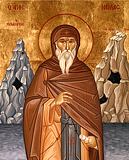
|
Next day |
| Old Style
November 12
|
Tuesday |
New Style
November 25
|
| 25th Week after Pentecost. Tone 7. |  No fast.
|
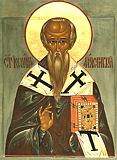
 St. John the Merciful, patriarch of Alexandria (616-620).
  St. Nilus the Faster, of Sinai (451).
Prophet Ahijah (Achias) (960 b.c.). Blessed John “the Hairy,” fool-for-Christ, of Rostov (1580). St. Nilus the Myrrh-gusher, of Mt. Athos (1651).
New Hieromartyrs Matthew Aloin, archpriest, of Myachkovo (Moscow), Constantine Uspensky, archpriest, of Vasyutino (Moscow), and Alexander Glagolev, archpriest, of Kiev (1937).
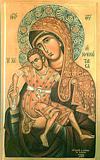
Icon of the Mother of God “the Merciful”.
St. Emilian, hermit, of Vergegio in Spain (574). St. Sinnell of Cleenish, Ireland (6th c.). St. Machar, bishop of Aberdeen (6th c.). St. Cadwaladr, king of the Welsh (664). St. Leontius, patriarch of Constantinople (ca. 1143). New Martyr Sabbas of Nigdea in Asia Minor, at Constantinople (1726). New Martyr Nicholas of Marmaran, at Constantinople (1732). New Martyrs and Confessors of Nasaud, Romania: Athanasius Todoran, Basil Dumitru, Gregory Manu, and Basil Oichi (1763). St. Sylvester, bishop of Kanev (1908).
Repose of Righteous Cosmas of Birsk (1882). Commemoration of the righteous monks and laymen buried at Optina Monastery, including virgin maiden Barbara (1900) and recent martyrs: Hieromonk Basil, Riassaphore-monks Trophimus and Therapontus (1993), and the youth George (1994).
Thoughts for Each Day of the Year
According to the Daily Church Readings from the Word of God
By St. Theophan the Recluse

Tuesday. [I Tim. 1:8-14; Luke 14:25-35]
Salt is good: but if the salt have lost his savor, wherewith shall it be seasoned? Salt are the disciples of the Lord, who passed on His directions to people, destroyed the moral rottenness in those people. If we will call such teaching education, then the title of salt should also pass to this. Then the entire saying will look like this: education is a good thing, but if education has lost its savor then what is it fit for? Give it up! Education acts like salt when it is filled with the principles and elements of the Lord’s teaching, when it itself consists of discipleship with the Lord; but as soon as it departs from this, and gives alien teachings instead of the Lord’s lessons, then it has lost its savour and becomes unprofitable. It becomes infected with the rottenness of delusion and lies, and begins to be not healing, but infectious. History has confirmed and continues to confirm this with experience everywhere. Why doesn’t anybody heed experience? The enemy brings darkness upon everyone and they all think that it is light, when in their teachings they remain far from the Lord’s teaching.
Wednesday. [I Tim. 1:18-20, 2:8-15; Luke 15:1-10]
The parable about the stray sheep and the lost silver piece. How great is the Lord’s mercy toward us sinners! He leaves all those who are proper and turns to the improper to correct them; He seeks them, and when He finds them, He Himself rejoices and calls all the heavens to rejoice with Him. How is it that He seeks them? Does He not know where we are who have stepped away from Him? He knows and sees all; but if it were only a matter of taking and transferring them to His own, all sinners would immediately reappear in the same ranks. But one must first dispose them to repentance, so that their conversion and return to the Lord would be free; and this cannot be done by command or other external order. The Lord seeks a sinner by guiding him to repentance. He arranges everything around him so that the sinner comes to his senses, and, seeing the abyss into which he has been rushing, returns. All the circumstances of life are directed in this way, all meetings with moments of sorrow and joy, even words and looks. And the inner actions of God through the conscience and other right thoughts lying in the heart never cease. How much is done to convert sinners to the path of virtue, while sinners still remain sinners!… The enemy covers them in darkness and they think that everything is all right, and all will pass. If worries arise they say, “Tomorrow I will stop,” and remain in their former state. Thus day after day passes; indifference to their salvation grows and grows. A bit more and it will harden into sin. Who knows if conversion will come?
Articles
 St John the Merciful, Patriarch of AlexandriaSaint John the Merciful, Patriarch of Alexandria, was born on Cyprus in the seventh century into the family of the illustrious dignitary Epiphanius. |
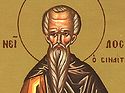 Venerable Nilus the Faster of SinaiSaint Nilus the Faster of Sinai, a native of Constantinople. He lived during the fifth century and was a disciple of St John Chrysostom. |
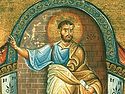 Prophet AhijahThe Holy Prophet Ahijah,was a contemporary of Solomon, and was born in the city of Shiloh. |
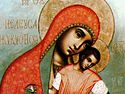 Icon of the Mother of God “the Merciful”This icon was painted, according to Tradition, by the holy Evangelist Luke. It received its name “Kykkiotisa” from Mount Kykkos, on the island of Cyprus. |