


| Previous day | 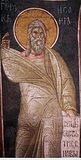
|
Next day |
| Old Style
May 9
|
Tuesday |
New Style
May 22
|
| 7th Week after Pascha. Tone 6. |  No fast.
|
 Prophet Isaiah (8th c. b.c.). Martyr Christopher of Lycia, and with him Martyrs Callinica, Aquilina, and 200 soldiers (ca. 250). St. Shio of Mgvime, monk, of Georgia (6th c.).
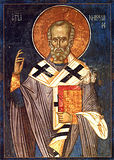
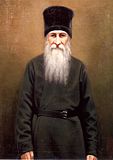
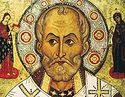
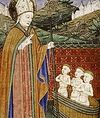
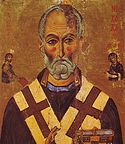
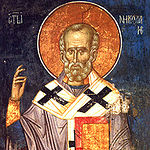
  Translation of the relics of St. Nicholas the Wonderworker from Myra to Bari (1087). St. Joseph, elder, of Optina Monastery (1911).
Translation of the relics of Child-martyr Gabriel of Slutsk (1775).
New Hieromartyr Dimitry Voskresensky, archpriest, of Anastasovo (Chuvashia) (1938).
Martyr Epimachus of Pelusium, at Alexandria (250). St. Maximus III, bishop of Jerusalem (ca. 350). Martyr Gordion, at Rome (362). Monk-martyr Nicholas of Vouneni in Thessaly (901).
Thoughts for Each Day of the Year
According to the Daily Church Readings from the Word of God
By St. Theophan the Recluse

Tuesday. [Acts 21:26–32; John 16:2–13]
When he, the Spirit of truth, is come, he will guide you into all truth (John 16:13). Why is this source of knowledge not mentioned in books of rhetoric? It is not surprising that this point is not in pagan books of rhetoric, but why is it not in Christian ones? Can it be that when a Christian begins to philosophize he ought to cease being a Christian and forget all the true and unquestionable promises which were given to him? People often explain how to see and hear; they also teach well enough to make generalizations and inductions from what is seen and heard. But when the time comes to unravel the meaning of it all, here the nursling of logic is left to the devices of his own guesswork. Why not suggest to him: you have the revelations of the spirit of truth—follow them. They resolve the meaning of all existence and events in an indisputable manner, for they proceed from God, in Whom lies the source of existence itself. Perhaps all the guessing has multiplied so greatly that now all books (about God’s world) are filled with just guesses precisely because no one remembers to make that suggestion? It would be alright if these books were at least a little worthwhile; but it is clear at first glance that they are but the fruit of childish imagination.
Articles
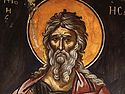 Prophet IsaiahThe Holy Prophet Isaiah lived 700 years before the birth of Christ, and was of royal lineage. |
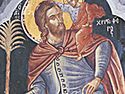 Martyr Christopher of LyciaThe Holy Martyr Christopher lived during the third century and suffered about the year 250, during the reign of the emperor Decius (249-251). |

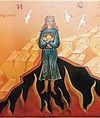 A Strange Miracle of St. Nicholas in 1956A true incident which shocked and brought repentance to hundreds of people in the Russian Soviet city of Kuibyshev (modern day Samara), in the year 1956. |
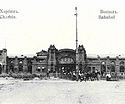

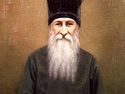 Venerable Joseph of OptinaSaint Joseph of Optina was born on November 2, 1837 in the village of Gorodishcha in the province of Kharkov. |