| Previous day | 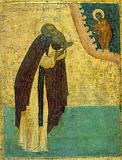
|
Next day |
| Old Style
August 30
|
Sunday |
New Style
September 12
|
| 12th Sunday after Pentecost. Tone 3. |  No fast.
|
 Sts. Alexander (340), John the Faster (595), and Paul the New (784), patriarchs of Constantinople. Repose of St. Alexander, founder of Svir Monastery (1533).
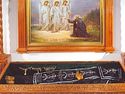
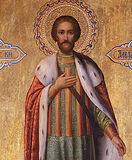
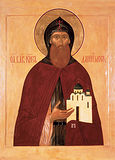
  Translation of the relics of St. Alexander Nevsky (Alexis in schema), great prince of Novgorod (1724). Uncovering of the relics of St. Daniel, great prince of Moscow (1652).
St. Christopher of Palestine (6th c.). St. Fantinus of Calabria (9th c.-10th c.). Synaxis of Serbian Hierarchs: Sts. Sava I (1235), Arsenius (1266), Sava II (1269), Eustathius I (1285), James (1292), Nicodemus (1325), and Daniel II (1338), archbishops; Sts. Ioannicius II (1354), Ephraim II (1395), Spyridon (1388), Cyril (1419), Nicon (ca. 1439), Macarius (1574), and Gabriel I (1659), patriarchs; and St. Gregory, bishop (1012). St. Alexander, founder of Voch Monastery, near Galich (14th-15th c.). St. Barlaam, metropolitan of Moldavia (1657).
New Hieromartyr Ignatius (Lebedev), schemaarchimandrite, of the Vysokopetrovsky Monastery (Moscow) (1938). New Hiero-confessor Peter Cheltsov, archpriest, of Smolensk (1972).
St. Bryaene of Nisibis (318). St. Sarmata of Egypt (ca. 362). St. Eulalius, bishop of Cyprus (4th c.). St. Fiacrius (Fiacre), Irish hermit and hospice-founder at Breuil in Brie (ca. 670). St. John of Rasca and Secu, bishop of Roman, Moldavia (1685). 16 Monk-martyrs of Thebes. Six Martyrs of Melitene.
Thoughts for Each Day of the Year
According to the Daily Church Readings from the Word of God
By St. Theophan the Recluse

Twelfth Sunday After Pentecost. [I Cor. 15:1-11; Matt. 19:16-26]
A rich man shall hardly enter into the Kingdom of Heaven. Here is meant a rich man who sees in his own self many methods and many powers unto his own prosperity. But as soon as one who has many possessions cuts off all attachment to them, extinguishes within himself all reliance on them, and ceases to see them as his substantial support, then in his heart he is the same as one who possesses nothing—for thus is the road to the kingdom open. Riches are then not only a hindrance, but a help, for they provide the means for charitable works. Riches are not the misfortune, but rather reliance upon them and attachment to them. This thought can be generalized in this way: whoever relies on something and is attached to something is rich in that thing. Whoever relies on God alone and cleaves to Him with all his heart is rich in God, Whoever relies on something else turns his heart to it instead of God—such a person is rich in this other thing, but not in God. From this it follows that he who is not rich in God has no entrance into the kingdom of God. Here are meant such things as birth, connections, mind, rank, circle of activities and so forth.
Articles