| Previous day | 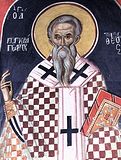
|
Next day |
| Old Style
July 9
|
Tuesday |
New Style
July 22
|
| 7th Week after Pentecost. Tone 5. |  No fast.
|
 Hieromartyr Pancratius, bishop of Taormina in Sicily (1st c.).
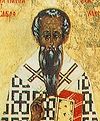
Hieromartyr Cyril, bishop of Gortyna on Crete (ca. 303). Monkmartyrs Patermuthius and Coprius, and Martyr Alexander the Soldier, of Egypt (361-363). Sts. Patermuthius and Coprius, ascetics, of Egypt (5th c.). St. Theodore, bishop of Edessa (9th c.). Uncovering of the relics of St. Gabriel, archimandrite of St. Elias Skete, Mt. Athos (1994). Hieromartyr Peter, priest, of Cherevkov (Vologda) (early 17th c.).
Hieromartyrs at Wurzburg: Killian, bishop in East Franconia and Thuringia, and his companions Hieromonk Colman and Hierodeacon Totman (689). St. Everild, abbess, of Northumbria (ca. 700). St. Theodosius, stylite, of Edessa (9th c.). St. Photius, founder of Akapniou Monastery in Thessalonica (10th c.). Sts. Dionysius the Rhetorician (1606) and Metrophanes (17th c.), of Little St. Anne’s Skete, Mt. Athos. New Hieromartyr Methodius, bishop of Lappa on Crete (1793).
Repose of Righteous Patermuphy of Valaam and St. Alexander Nevsky Lavra (ca. 1825), Hierodeacon Melchizedek of the Roslavl Forests (1840), and Priest Ilie Lacatusu of Romania (1983).
Thoughts for Each Day of the Year
According to the Daily Church Readings from the Word of God
By St. Theophan the Recluse

Monday. [I Cor. 5:9-6:11; Matt. 13:54-58]
The Nazarenes did not believe the word of the Lord, because when He lived in amongst them, He had no attractive lustre or outward dignity that would command involuntary respect from all. “We know who He is,” they said; “there can’t be anything extraordinary about Him.” Their reaction, however, did not induce the Lord to assume an imposing appearance. He remained extremely simple in appearance; later the Apostles bore themselves the same way, as did all of those who truly followed and emulated them. Why is this so? Because it is there is no man-made lustre that could fully correspond to the light of life in Jesus Christ. Moreover, we recognize that it is better to relegate external appearance the lowest value, so that it does not block what is within. Let him who has eyes to see look directly at the latter, without arresting his attention upon the former. The holy Apostle Paul expressed it like this: We have this treasure in earthen vessels (II Cor. 4:7). If we could see what was the outward appearance of those persons whom we now revere and call upon in prayer, we would not believe our eyes—they were so simple. But to this day, those who have come to know the life in Jesus Christ abandon care for their outward appearance and turn fully within. That is why the former falls away on its own, but the latter is raised up and grows. It often happens that nobody even notices this inner brightness, not even the one who possesses it. The human eye is evil; it is not shown what is truly good, if this good can harm it.
Tuesday. [I Cor. 6:20-7:12; Matt. 14:1-13]
A rumour of the works of the Lord reached Herod; he immediately concluded: it is John resurrected. One could have thought anything. Yet he did not think of anyone except John. Who gave such a direction to his thoughts? His conscience. From it you cannot hide unconscionable deeds; you cannot correct its judgement with anything. Herod assumed the right to behead John, and others did not deny that he had the right, but his conscience spoke, and he could not muffle its words with anything. That is why he immediately saw John. How many similar instances do we know where the conscience pursues a sinner and paints the subject and deed of a sin so that he sees them even outside himself! There is a voice in us that we must acknowledge is not our voice. Whose is it? God’s. He who gives us our nature, gives us this voice. If it is God’s voice, we must obey it, for creatures dare not contradict the Creator. This voice says that God exists, that we completely depend upon Him, and therefore we cannot not but have a reverent fear of God; having this fear, we must fulfil God’s will, which conscience indicates. All of this makes up the word of God, written in our nature, read and offered to us. And we see that people of all times and all countries hear this word and heed it. Everywhere people believe in God, everywhere they listen to their conscience and await the future life. Only now has it somehow become fashionable to not acknowledge these truths. This is how the naturalists behave; which means that the teaching which the naturalists preach is unnatural.
Articles