| Previous day | 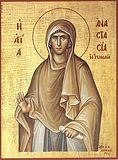
|
Next day |
| Old Style
October 30
|
Wednesday |
New Style
November 12
|
|
23rd Week after Pentecost.
Tone 5.
Fast Day. |
 Wine and oil allowed.
|
 Hieromartyr Zenobius, bishop of Aegae in Cilicia, and his sister Zenobia (285).
Apostles Tertius (Terence), Mark, Justus, and Artemas, of the Seventy (1st c.). Hieromartyr Marcian, bishop of Syracuse (2nd c.). Martyr Eutropia of Alexandria (250). St. Stephen Milutin, king of Serbia (1320), his brother St. Dragutin (monk Theoctistus) (1316), and their mother St. Helen (1306), wife of Urosh I of Serbia. Martyr Iotam Zedghinidze, near Lake Paravani (Georgia) (1465). Uncovering of the relics of St. Eutropia of Kherson (2009).
New Hiero-confessor Nicanor (Kudryavtsev), bishop of Bogorodsk (1923).
Martyrs Alexander, Cronion, Julian, Macarius, and 13 companions, at Alexandria (250). St. Asterius, metropolitan of Amasea (before 431). St. Joseph I, patriarch of Constantinople (1283). Finding of the relics of Great-martyr Stephen-Urosh III of Decani, Serbia (1338). New Hiero-confessor Varnava (Nastic), bishop of Hvosno (1964). Apostle Cleopas of the Seventy, brother of Righteous Joseph the Betrothed (1st c.).
Repose of Archimandrite Boris (Kholchev) of Tashkent (1971).
Thoughts for Each Day of the Year
According to the Daily Church Readings from the Word of God
By St. Theophan the Recluse

Wednesday. [I Thess. 4:1-12; Luke 11:42-46]
The Lord reproaches His contemporaries by saying that they pass over the judgement and the love of God. The drying up of righteousness and love is the root of all disharmony both in society and in every person. It comes from the predominance of self-love or egoism. When egoism enters the heart an entire horde of passions is multiplied. It itself strikes out against righteousness and love, which require selflessness; while the passions generated from it chase away all other virtues. And the person becomes, by his heart’s disposition, unsuitable for anything that is truly good. He can still tithe mint and rue and all manner of herbs, but he does not have the courage to do anything more substantial. This does not mean that his outer behaviour is improper. No, in every way it is adorned with decency, only on the inside he is as a grave which appeareth not, and the men that walk over it are not aware of it. The beginning of self-correction is the beginning of the appearance of selflessness in the heart, after which righteousness and love are restored. Then, one after the other, all other virtues begin coming to life. Then the person becomes noble in the eyes of God because of his heart’s dispositon, although on the outside he may sometimes seem unprepossessing to other people. But the judgement of man is not an important thing, provided that God’s judgement is not against us.
Articles
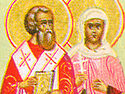
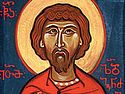
 Apostle Tertius of the SeventySaint Tertius, to whom Saint Paul dictated the Epistle to the Romans, was the second Bishop of Iconium, where also he died. |
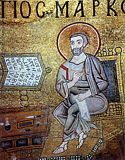
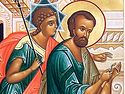 Apostle and Evangelist MarkThe Holy Apostle and Evangelist Mark, also known as John Mark (Acts 12:12), was one of the Seventy Apostles, and was also a nephew of Saint Barnabas (June 11). |
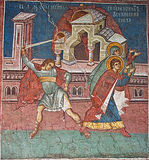
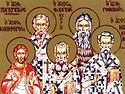 Hieromartyrs Marcellus, Bishop of Sicily, Philagrius, Bishop of Cyprus, and Pancratius, Bishop of TaorminaThey were put to death for spreading the faith of Christ among the pagans. |
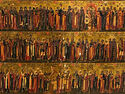 Martyr Eutropia of AlexandriaThe Martyr Eutropia suffered for Christ in Alexandria in about the year 250. |
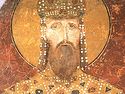 St Stephen Milutin of SerbiaSaint Stephen was the younger son of King Stephen Urosh I, and grandson of First-Crowned King St Stephen. He ruled Serbia from 1275 to 1320. |
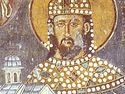
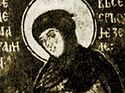 St Helen of SerbiaSaint Helen, a pious mother to her sons Stephen Milutin and Dragutin, devoted her whole life to pious deeds after the death of her husband. |