


| Previous day | 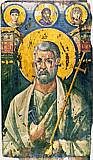
|
Next day |
| Old Style
January 16
|
Thursday |
New Style
January 29
|
| 34th Week after Pentecost. Tone 8. |  No fast.
|
 Veneration of the Precious Chains of the Holy and All-glorious Apostle Peter.
  Blessed Maximus, priest of Totma (Vologda), fool-for-Christ (1650).
Martyrs Speusippus and his brothers Eleusippus and Meleusippus, their grandmother Leonilla, and with them Neon, Turbo, and Jonilla (Jovilla), in Cappadocia (161-180). Martyr Danax the Reader, in Macedonia (2nd c.). St. Honoratus, archbishop of Arles and founder of Lerins Monastery (429).
St. James of Tarentaise (429). St. Fursey, Irish missionary monk of Burgh Castle (East Anglia), Lagny, and Peronne (Gaul) (650). St. Romilus the Sinaite, of Ravanica Monastery (Serbia) (1375). St. Gerasimus II, patriarch of Alexandria (1714). New Hieromartyr Damascene of Gabrovo, hieromonk of Hilandar, at Svishtovo (1771). New Hieromartyr Nicholas, priest, of Mytilene (1777).
Repose of Elder Theodore of Irkutsk (1923) and Priest Demetrius Gagastathis of Platanos, Trikala (1975).
Thoughts for Each Day of the Year
According to the Daily Church Readings from the Word of God
By St. Theophan the Recluse

Thursday. [I Pet. 4:12–5:5; Mark 12:38–44]
The widow placed in the treasury (the church collection box) two mites (a half-kopeck piece, approximately); but the Lord said that she cast in more than anyone, although the others were casting in rubles and tens of rubles. What gave extra weight to her mite? It is the disposition with which the offering was made. Do you see the difference between the doing of good without soul, by habit, and the doing of good with soul and heart? It is not the external aspects of a deed which give it value, but the inner disposition. It may happen that a deed which is outstanding in every regard has no value whatsoever before God, yet a deed which is insignificant in appearance is valued greatly. What follows from this is evident in and of itself. But do not take it into your head to be careless about external things, intending to limit yourself only to inner things. That widow would not have received approval if she had said to herself, “I too have the desire to put in money—but what should I do? I only have two mites. If I give them away, I myself will be left with nothing. She had the desire and acted upon it as well, committing her life into the hands of God. Nobody would have condemned her If she had put in nothing—neither people, nor God. But then she would not have revealed such a disposition, which singled her out from the ranks of others and made her renowned throughout the entire Christian world.
Friday. [II Pet. 1:1–10; Mark 13:1–8]
Having enumerated the virtues which we must seek with all diligence, having received grace-filled power, the Apostle says by way of encouragement, If these things be in you, and abound, they make you that ye shall neither be barren nor unfruitful in the knowledge of our Lord Jesus Christ (II Pet. 1:8). The virtues to which he refers here were mentioned in I Pet. 2:21–3:9. Now we shall add only that we are required to manifest these virtues not just once, but rather to make them always abide in us, to be part of our essence, to take root in us. Thus, they must not remain on one level, but ever multiply and grow in strength and fruitfulness. Only then, he says, will you not be barren and unfruitful in the knowledge of our Lord Jesus Christ (II Pet. 1:8). He who believes in Him and confesses Him enters into the knowledge of the Lord. “You believe?” says the Apostle! See then, that your faith be not barren and unfruitful. What should I do, so that my faith will not be that way? Prosper in every virtue. Where are those who repeat over and over that believing is enough: that nothing more is needed?! Whoever thinks this way is blind.
Articles
 The apostles Peter and Paul |
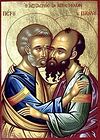
 The Holy Glorious and All-Praised Leaders of the Apostles, Peter and PaulSermon of Saint Augustine, Bishop of Hippo |


 Blessed Maximus the Fool-for-Christ of Totma, VologdaBlessed Maximus, Priest of Totma, was for a certain time, a priest in the city of Totma in the Vologda diocese. |


 Martyr Danax the Reader, in MacedoniaThe Holy Martyr Danax lived during the second century and served as reader at a church in Auleneia in Macedonia. |
 St. Honoratus the Archbishop of Arles and Founder of Lerins MonasterySaint Honoratus was born in Gaul (modern France) about 350, and came from a distinguished Roman family. |

 Venerable Romilus of RavenicaSaint Romilus the Hesychast was the disciple of Saint Gregory of Sinai (August 8). He was born in Vidin, Bulgaria of a Greek father and a Bulgarian mother. |
