


| Previous day | 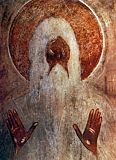
|
Next day |
| Old Style
January 19
|
Sunday |
New Style
February 1
|
| Sunday of the Publican and the Pharisee. Tone 1. |  No fast.
|
 St. Macarius the Great of Egypt (390-391).
  St. Mark, archbishop of Ephesus (1444). Blessed Theodore of Novgorod, fool-for-Christ (1392). St. Macarius the Roman, abbot (Novgorod) (16th c-17th c.).
Virgin-martyr Euphrasia of Nicomedia (303). St. Macarius of Alexandria (394-395). St. Anthony the Stylite, of Martqopi, Georgia (6th c.). St. Arsenius, archbishop of Corfu (8th c.). St. Macarius the Faster, of the Kiev Caves (12th c.). St. Macarius, hierodeacon of the Kiev Caves (13th c.-14th c.). Uncovering of the relics of St. Sabbas, founder of Storozhev Monastery (Zvenigorod) (1652).
New Hieromartyr Peter Skipetrov, archpriest, of Petrograd (1918).
St. Branwalader (Breward) of Cornwall and the Channel Islands (6th c.). Martyr Anthony Rawah the Qoraisite (797). Translation of the relics (950) of St. Gregory the Theologian (389). St. Meletius, confessor, of Mt. Galesion, monk (1286).
Repose of Schemanun Anatolia of Diveyevo (1949).
Thoughts for Each Day of the Year
According to the Daily Church Readings from the Word of God
By St. Theophan the Recluse

Sunday of the Publican and the Pharisee (33rd). [II Tim. 3:10–15; Luke 18:10–14]
Yesterday the Gospel reading taught us persistence in prayer, and now it teaches humility, or a feeling of having no right to be heard. Do not assume that you have the right to be heard, but approach prayer as one unworthy of any attention, allowing yourself only the boldness needed to open your mouth and raise up your prayer to God, knowing the Lord’s boundless condescension toward us poor ones. Do not even allow the thought to come to your mind, “I did such and such—so give me such and such.” Consider whatever you might have done as your obligation. If you had not done it you would have been subject to punishment, and what you did is actually nothing deserving reward; you did not do anything special. That Pharisee enumerated his rights to be heard, and left the church with nothing. The harm is not that he had actually done as he said, for indeed he should have done it. The harm is that he presented it as something special; whereas, having done it he should have thought no more of it. Deliver us, O Lord, from this sin of the Pharisee! One rarely speaks as the Pharisee in words, but in the feelings of the heart, one is rarely unlike him. For why is it that people pray badly? It is because they feel as though they are just fine in the sight of God, even without praying.
Articles
 Venerable Macarius the Great of EgyptAfter he buried his wife, Macarius told himself, “Take heed, Macarius, and have care for your soul. It is fitting that you forsake worldly life.” |
 St. Mark the Archbishop of EphesusSaint Mark Eugenikos, Archbishop of Ephesus, was a stalwart defender of Orthodoxy at the Council of Florence. |
 Righteous Theodore of Novgorod the Fool-For-ChristBlessed Theodore of Novgorod was the son of pious parents, wealthy citizens of Novgorod. |

 Virginmartyr Euphrasia of NicomediaThe Holy Virgin Martyr Euphrasia was born at Nicomedia into an illustrious family. She was a Christian, and was noted for her beauty. |


 Venerable Macarius the Faster, of the Kiev Near CavesSaint Macarius the Faster of the Near Caves of Kiev was a deacon. |
 Venerable Macarius the Deacon of the Kiev CavesSaint Macarius lived during the thirteenth-fourteenth centuries, and was distinguished by his lack of covetousness. |


 The Sunday of the Publican and the Pharisee |