


| Previous day | 
|
Next day |
| Old Style
January 26
|
Sunday |
New Style
February 8
|
| Sunday of the Prodigal Son. Tone 2. |  No fast.
|
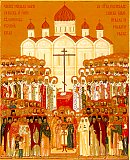
 Sunday of the Holy New Martyrs and Confessors of Russia.
  St. Xenophon and his wife St. Mary, and their two sons Sts. Arcadius and John, of Constantinople (5th c.-6th c.).
Martyrs Ananias the priest, Peter the prison guard, and seven soldiers, in Phoenicia (295). St. Symeon the Ancient, of Mt. Sinai (390). St. Joseph the Confessor, archbishop of Thessalonica, brother of St. Theodore the Studite (830). Translation of the relics of St. Theodore the Confessor, abbot of the Studion (826). St. David the Builder, king of Georgia (1125). St. Xenophon, founder of Robeika Monastery (Novgorod) (1262).
St. Ammon of Egypt (350), disciple of St. Anthony the Great. St. Paula of Rome, monastic foundress in Palestine (404). St. Gabriel, abbot, in Jerusalem (ca. 490). St. Conon, bishop and monastic founder on the Isle of Man (648). St. Clement of Mt. Sagmation (12th c.).
Repose of Metropolitan Gabriel of Novgorod and St. Petersburg (1801), Metropolitan Joseph (Naniescu) of Suceava, Romania (1902) and Archimandrite Luka (Anic) of Dajbabe, Montenegro (2013).
Thoughts for Each Day of the Year
According to the Daily Church Readings from the Word of God
By St. Theophan the Recluse

Sunday of the Prodigal Son (34th). [I Cor. 6:12–20; Luke 15:11–32]
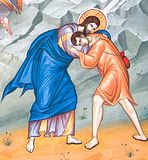
The week of the prodigal speaks of so much to us! It speaks about our peace and satisfaction in the house of the heavenly Father, about our mad departure from the Father’s guardianship to unbridled freedom, about the richness of the heritage given us despite our disobedience, about its reckless waste on all sorts of indecencies, and about our utter impoverishment as a result. But then it talks also about how one recovers his senses, and, coming to himself, decides to return to his greatly merciful Father. It talks about how he returns, how he is received lovingly, and is restored to his first state. Who will not find this lesson profitable? If you abide in your father’s house, do not strive for freedom. You see how a similar experience ended! If you have run away and are squandering all, end this quickly. If you have already squandered everything and are living in poverty, decide quickly to return—and then, return. There every indulgence, and all the former love and satisfaction, await you. This last step is the most necessary one. But there is no point in enlarging upon this. All has been said concisely and clearly. Come to your senses, decide to return, arise and hurry to the Father. His embrace is open and ready to receive you.
Articles
 Saint Xenophon, his wife Maria, and their sons Arcadius and JohnSaint Xenophon, his wife Maria, and their sons Arcadius and John, were noted citizens of Constantinople and lived in the fifth century. |

 Presbyter Ananias in PhoeniciaThe Holy Martyrs Ananias the Presbyter, Peter the prison guard, and seven soldiers suffered in Phoenicia in the year 295. |
 Martyr Peter, in PhoeniciaSaint Peter was a prison guard who suffered in Phoenicia in the year 295 with the holy martyr Ananias the Presbyter and seven soldiers. |


 Venerable Xenophon the Abbot of Robeika, NovgorodSaint Xenophon of Robeika was a student of St. Barlaam of Khutyn. |
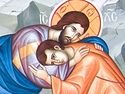


 The Sunday of the Prodigal SonThe Sunday of the Prodigal Son |
