


| Previous day | 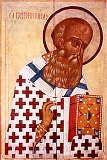
|
Next day |
| Old Style
January 25
|
Saturday |
New Style
February 7
|
| Fast-free Week. Tone 1. |  No fast.
|
 St. Gregory the Theologian, archbishop of Constantinople (389). St. Anatole I (Zertsalov), elder, of Optina Monastery (1894).
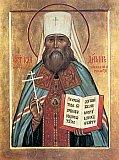
  New Hieromartyr Vladimir, metropolitan of Kiev, protomartyr of the Communist yoke in Russia (1918).
Martyrs Felicitas of Rome and seven sons: Januarius, Felix, Philip, Silvanus, Alexander, Vitalis, and Martial (ca. 164). St. Publius, ascetic, of Euphratensis in Syria (ca. 380). St. Mares the Singer, of Omeros near Cyrrhus (ca. 430). St. Moses, archbishop of Novgorod (1362). St. Gregory, abbot, of Staro-Golutvin Monastery and bishop of Kolomna (15th c.).
New Hieromartyrs Peter (Zverev), archbishop of Voronezh (1929) and Basil (Zelentsov), bishop of Priluki (1930). New Martyr Abbess Margaret (Gunaronulo) of Menzelino (1918). New Martyr Athanasia (Lepeshkin), abbess of the Smolensk Hodigitria Convent, near Moscow (1931).
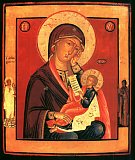
Icons of the Most Holy Theotokos “Assuage My Sorrow” and “Unexpected Joy.” (1640)
St. Castinus, bishop of Byzantium (240). St. Bretanion (Vetranion), bishop of Tomis in Moesia (ca. 380). St. Apollo of the Thebaid, monk (4th c.). Hieromartyr Praejectus, bishop of Clermont (676). St. Demetrius, the skevophylax (“keeper of the sacred vessels”), of Constantinople (8th c.). New Martyr Auxentius of Constantinople (1720). St. Gabriel, bishop of Imereti (Georgia) (1896).
Repose of Archpriest Sergius Orlov of Akulovo (1975).
Thoughts for Each Day of the Year
According to the Daily Church Readings from the Word of God
By St. Theophan the Recluse

310
Saturday. [II Tim. 3:1–9; Luke 20:45–21:4]
Who are those having a form of godliness, but denying the power thereof? (II Tim. 3–5). Who are those others, ever learning, and never able to come to the knowledge of the truth? (II Tim. 3:7). The former are those who maintain all the external routines in which a godly life is manifested, but who do not have a strong enough will to maintain their inner dispositions as true godliness demands. They go to church and stand there readily. But they do not make the effort to stand with their mind before God continuously and to reverently fall down before Him. Having prayed a bit, they release the reins of the control of their mind; and it soars, circling over the entire world. As a result, they are externally located in church, but by their inner state they are not there: only the form of godliness remains in them, while its power is not there. You must think about everything else in this manner.
The latter are those who, having entered the realm of faith, do nothing but invent questions—“What is this? What is that? Why this way? Why that way?” They are people suffering from empty inquisitiveness. They do not chase after the truth, only ask and ask. And having found the answer to their questions, they do not dwell on them for long, but soon feel the necessity to look for another answer. And so they whirl about day and night, questioning and questioning, and never fully satisfied with what they learn. Some people chase after pleasures, but these chase after the satisfaction of their inquisitiveness.
Articles

 Venerable Anatole I of OptinaFrom a very early age, Alexis wanted to become a monk. He even thought about going to the Roslavl forests to live with the hermits at that place. |
 St. Vladimir, Metropolitan of Kiev and GallichThe holy Metropolitan Vladimir of Kiev was the first bishop to be tortured and slain by the Communists at the time of the Russian Revolution. |

 St. Publius the Ascetic of SyriaSaint Publius of Syria was born in the city of Zeugma on the Euphrates and was a senator. |
 St. Mares the Singer in SyriaSaint Mares the Singer lived in a hut in fasting and prayer for thirty-seven years in the village of Homeron, not far from the city of Cyrrhus in Syria. |


