


| Previous day | 
|
Next day |
| Old Style
April 25
|
Friday |
New Style
May 8
|
|
4th Week after Pascha.
Tone 3.
Fast Day. |
 Fish, wine and oil allowed.
|
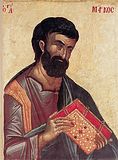
 Holy Apostle and Evangelist Mark (63).
St. Sylvester, abbot, of Obnora Monastery (1379). St. Basil, elder, of Poiana Marului (1767).
New Hieromartyr Sergius Rokhletsov, archpriest, of Veliki Ustiug (1938).
St. Annianus, second bishop of Alexandria (86). Hieromartyr Stephen, patriarch of Antioch (479). St. Rusticus, archbishop of Lyon (501). St. Macedonius, patriarch of Constantinople (516). St. Bassian the Blind, hieroschemamonk of the Kiev Caves (1827).
Repose of Elder Philotheus (Zervakos) of Paros (1980).
Thoughts for Each Day of the Year
According to the Daily Church Readings from the Word of God
By St. Theophan the Recluse

Friday. [Acts 10:44–11:10; John 8:21–30]
They asked the Lord: Who art Thou? He answered: Even the same ... from the beginning (John 8:25). He is in front, behind Him are the holy Apostles, behind the Apostles are the pastors and teachers and the entire Church of Christ. Judge now who are the true avant guarde. Since for so long so many have followed them and will still follow them, they have not ceased to be in front, for they continue to be in front, while all others follow them. Thus for us Christians there already is an avant guarde; and if someone attempts to push new people to the fore—it is obvious that they must be understood as being an avant guarde heading in the opposite direction; that is, on the path which leads to the bottom of hell. There is nothing to add to this. Be on your guard—for who among you is an enemy to himself? Try only to understand this in a real way; hold firmly to the known truth of Christ, and let the others say what the may.
Wednesday. [Gal. 3:15-22; Mark 6:7-13]
When the Lord sent the holy apostles to preach, He commanded that they not take anything with them but the clothes on their backs, sandals on their feet, and staff in hand. They were to have no cares about anything, entering in to this work as if everything were fully provided. Indeed, the apostles were completely provided for, without any external provisions. How was this arranged? Through their complete devotion to the will of God; that is why the Lord arranged for them not to have any need for anything. Their preaching moved the hearts of listeners, who fed and sheltered the preachers. But the apostles did not think of this and did not expect anything, committing all to the Lord. That is why they bore any unpleasantness they might have encountered patiently. Their only care was to preach, and their only sorrow was if people would not listen to their preaching. From this came the purity, independence and great fruitfulness of their preaching. The same is needed today as well, but our infirmity demands external provision, without which we will not take a step. This, however, is not a reproach against our apostles of today. In the beginning they definitely find comfort in being provided for, but then the thought of it disappears from their mind, and through their very labour they are raised up to the state of committing themselves to God. Very likely from that moment their preaching begins to be truly fruitful. Committing oneself to God is a very high degree of moral perfection, and people do not reach it immediately the moment they understand its value. It comes on its own after labors over oneself.
Articles
 Apostle and Evangelist MarkThe Holy Apostle and Evangelist Mark, also known as John Mark (Acts 12:12), was one of the Seventy Apostles, and was also a nephew of Saint Barnabas (June 11). |

