


| Previous day | 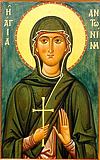

|
Next day |
| Old Style
June 13
|
Friday |
New Style
June 26
|
|
4th Week after Pentecost.
Tone 2.
Fast of the Holy Apostles. |
 Monastic rule: xerophagy (bread, uncooked fruits and vegetables).
|
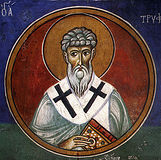
 Martyr Aquilina of Byblos in Lebanon (293). St. Alexandra, foundress of Diveyevo Convent (1789). St. Triphyllius, bishop of Leucosia (Nicosia) on Cyprus (ca. 370).
Martyr Antonina of Nicaea (ca. 284-305). St. Anna of Larissa in Thessaly (826) and her son John (9th c.). St. Andronicus, disciple of St. Sergius of Radonezh (1395), and St. Sabbas (15th c.), abbots, and St. Daniel (1428), iconographer, all of Moscow. Sunday of All Saints of Palestine. Sunday of All Saints of Romania. Sunday of All Saints of Bulgaria. Sunday of All Saints of the Iberian Peninsula. Sunday of All Saints of the Czech Lands. Sunday of All Saints of America.
Synaxis of New Martyrs and Confessors of Zaporozhie (Ukraine).
Kaluga Icon of the Most Holy Theotokos (1748).
St. Antipater, bishop of Bostra in Arabia (458). New Hieromartyr Anthimus the Georgian, metropolitan of Wallachia (1716). Martyr Diodorus of Emesus.
Repose of Archimandrite Dimitry (Egorov) of Santa Rosa, California (1992).
Thoughts for Each Day of the Year
According to the Daily Church Readings from the Word of God
By St. Theophan the Recluse

Friday. [Rom. 11:25-36; Matt. 12:1-8]
If ye had known what this meaneth, I will have mercy, and not sacrifice, ye would not have condemned the guiltless. Thus, in order to be saved from the sin of condemnation, we must obtain a merciful heart. A merciful heart not only does not condemn a seeming infringement of the law, but neither will it condemn an obvious one. Instead of judgment it feels pity, and would sooner weep than reproach. Truly the sin of condemnation is the fruit of an unmerciful, malicious heart that takes delight in debasing its neighbor, in blackening its neighbor’s name, in trampling his honor underfoot. This is a murderous affair, and is done in the spirit of the one who is a murderer from the beginning [John 8:44]. Here there occurs much slander as well, which comes from the same source—for that is what the devil is, a slanderer, spreading slanderousness everywhere. Hurry to arouse pity in yourself every time the evil urge to condemn comes over you. Then turn in prayer to the Lord with a compassionate heart, that He might have mercy upon all of us, not only upon the one whom we wanted to condemn, but upon us as well—perhaps even more so upon us—and the evil urge will die.
Articles
 Martyr Aquilina of Byblos in SyriaThe Holy Martyr Aquilina, a native of the Phoenician city of Byblos, suffered under the emperor Diocletian (284-305). |

 Martyr Antonina of Nicea, in BithyniaAfter fierce tortures, Saint Antonina was thrown into prison, but Maximian could not force the saint to renounce Christ and offer sacrifice to idols. |
 St. Anna and Her Son of ConstantinopleSaint Anna and her son Saint John lived in the ninth century. |

 Venerable Sava the Abbot of MoscowSaint Sava of Moscow succeeded Saint Andronicus as the igumen of the monastery of the Savior, dedicated to the Icon of Christ Not-Made-By Hands (August 16) in 1395. |
