| Previous day | 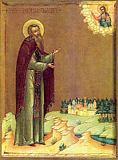
|
Next day |
| Old Style
June 12
|
Thursday |
New Style
June 25
|
|
4th Week after Pentecost.
Tone 2.
Fast of the Holy Apostles. |
 Wine and oil allowed.
|
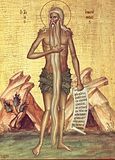
 St. Onuphrius the Great (4th c.).
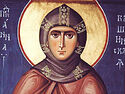
  St. Peter of Mt. Athos (734).
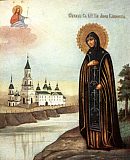
Sts. John, Andrew, Heraclemon, and Theophilus, hermits, of Egypt (4th c.). St. Arsenius, founder of Konevits Monastery (1447). St. Onuphrius, founder of Malsk Monastery (Pskov) (1492). Sts. Onuphrius and Auxentius, monks, of Vologda (15th c.-16th c). St. Stephen of Komel, founder of Ozersk Monastery (Vologda) (1542). Sts. Jonah and Bassian, monks, of Pertoma (Solovki) (1561). First (1650) and second (1909) glorifications of St. Anna, princess of Kashin (Euphrosyne in monasticism). St. Onuphrius, founder of Katrom Monastery (Vologda) (16th c). Uncovering of the relics of St. John of Moscow, fool-for-Christ (1672).
Miracle-working icons of the Theotokos and St. Onuphrius at St. Onuphrius Monastery (Poland). Valaam Icon of the Most Holy Theotokos.
St. Amphianus, bishop and confessor, in Cilicia (ca. 310). St. Olympius, bishop and confessor, in Thrace (4th c.). St. Timothy the Hermit, of Egypt (4th c.). Virgin-martyr Cunera of Rhenen (Neth.) (451). St. Julian of the Dagouta Church in Constantinople. St. John the Soldier, of Egypt (6th c.-7th c.). St. John (Tornicus) of Mt. Athos and Georgia (998). Synaxis of the Saints of St. Onuphrius Monastery at Jablechna (Poland). St. Triphyllius, bishop of Leucosia [Nicosia] on Cyprus (370). St. Nicephorus (Cantacuzene), archdeacon, of Constantinople, who suffered under the Uniates in Marienburg, Galicia (1599).
Repose of Elder Peter of Katounakia, Mt. Athos (1867), and Blessed Hermit Philaretus of Mt. Athos (1961).
Thoughts for Each Day of the Year
According to the Daily Church Readings from the Word of God
By St. Theophan the Recluse

Thursday. [Rom. 11:13-24; Matt. 11:27-30]
Come unto Me, all ye that labor and are heavy laden, and I will give you rest. O divine, O dear, O sweetest voice of Thine! Let us all follow the Lord Who calls us! But first we must feel something difficult and burdensome for us. We must feel that we have many sins, and that these sins are grave. From this feeling is born the need to seek relief. Faith will then show us that our only refuge is in the Lord and Saviour, and our steps will direct themselves toward Him. A soul desiring to be saved from sins knows what to say to the Lord: “Take my heavy, sinful burden from me; and I will take on Thy easy yoke.” And it happens like this: the Lord forgives the sins, and the soul begins to walk in His commandments. The commandments are the yoke, and sins are the burden. But comparing the two, the soul finds that the yoke of the commandments is light as a feather, while the burden of sins is heavy as a mountain. Let us not fear readily accepting the Lord’s easy yoke and His light burden. In no other way can we find rest unto our souls.
Articles


 Venerable John the Hermit of EgyptSaint John the Hermit lived in Egypt in the fourth century, and is mentioned in the Life of Saint Onuphrius. |
 Venerable Andrew the Hermit of EgyptSaint Andrew lived in Egypt in the fourth century, and is mentioned in the Life of Saint Onuphrius. |
 Venerable Heraclemon the Hermit of EgyptSaint Heraclemon lived in Egypt in the fourth century, and is mentioned in the Life of Saint Onuphrius. |
 Venerable Theophilus the Hermit of EgyptSaint Theophilus lived in Egypt in the fourth century, and is mentioned in the Life of Saint Onuphrius. |