


| Previous day | 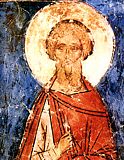
|
Next day |
| Old Style
June 21
|
Saturday |
New Style
July 4
|
|
5th Week after Pentecost.
Tone 3.
Fast of the Holy Apostles. |
 Fish, wine and oil allowed.
|
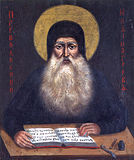
 Martyr Julian of Tarsus in Cilicia (ca. 284-305). Uncovering of the relics of St. Maximus the Greek, of Russia (1996).
Hieromartyr Tertius (Terence) apostle of the Seventy, bishop of Iconium (1st c.). St. Julius, priest, of Novara, and his brother St. Julian, deacon (5th c.). Martyrs Archil II (744) and Luarsab II (1622), kings of Georgia. Martyr Theodore, right-believing prince of Starodub (1330).
New Hieroconfessor George (Lavrov), archimandrite, of Kaluga (1932). New Hieromartyr Nicholas Rozanov, archpriest, of Zvenigorod (1938). New Hieromartyr Jonah (Sankov), hieromonk, of Alpatievo (Moscow) (1938).
St. Cormac of the Sea, abbot, of Durrow Monastery (Ireland) (ca. 590). St. Raoul (Rudolph or Ralph), abbot, and archbishop of Bourges (Gaul) (866). Martyr Aphrodisius in Cilicia. New Martyr Nicetas of Nisyros, near Rhodes, at Chios (1732). Martyr Julian and his wife Basilissa, and with them Martyrs Celsius, his mother Marcianilla, Anastasius, the priest Anthony, seven brothers, and twenty prison guards, of Antinoe in Egypt (283- 305).
Repose of Schemamonk John “the Muscovite,” of Valaam (1933).
Thoughts for Each Day of the Year
According to the Daily Church Readings from the Word of God
By St. Theophan the Recluse

Saturday. [Rom. 8:14-21; Matt. 9:9-13]
When someone, by his fear of God and the demands of his conscience already has an awakened thirst for spiritual things, he possesses a certain sense enabling him to understand the meaning of words relating to the spiritual sphere, although they might be clothed in the form of a parable. For such people a parable does not hide the truth, but rather reveals it even more clearly. But he who is not of this disposition does not understand any spiritual content described in the form of a parable. Even if one were to offer him a word on these subjects that was not in the form of a parable he would only understand the words, and not comprehend the essence of the matter. It would go against all of his notions, and seem to him to be an absurdity which he would not hesitate to mock. This is precisely why the Lord talked to the people in parables. Whoever is spiritually inclined will understand a parable, whereas someone with no inclinations will not understand no matter what you say. Because they seeing see not; and hearing they hear not, neither do they understand…For this people’s heart is waxed gross (Matt. 13:12-15). Meanwhile, the parable did not deprive of needed instruction those who were capable of seeing the hidden truth: For whosoever hath, to him shall be given, and he shall have more abundance.
Articles
 Martyr Julian of Tarsus, in CiliciaThe Holy Martyr Julian of Tarsus was born in the Asia Minor province of Cilicia. He was the son of a pagan senator, but his mother was a Christian. |


 Hieromartyr Terence the Bishop of IconiumSaint Terence was Bishop of Iconium in Lycaonia in the first century. |
 Apostle Tertius of the SeventySaint Tertius, to whom Saint Paul dictated the Epistle to the Romans, was the second Bishop of Iconium, where also he died. |


 Martyr Archil II the King of GeorgiaThe Holy Martyr Archil II, King of Georgia belonged to the dynasty of the Chosroidoi, and he was a direct descendant of the holy emperor St Mirian (+ 342). |
 Martyr Luarsab II the King of GeorgiaThe Holy Martyr Luarsab II, Emperor of Georgia was born in 1587. He was the son of George X (1600-1603), poisoned by the Persian shah Abbas I (1584-1628). |