


| Previous day | 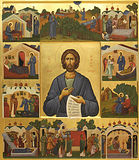
|
Next day |
| Old Style
September 12
|
Friday |
New Style
September 25
|
|
17th Week after Pentecost.
Tone 7.
Fast Day. |
 Wine and oil allowed.
|
 Apodosis of the Nativity of the Theotokos.
  Hieromartyr Autonomus, bishop, in Italy (313). St. Athanasius, disciple of St. Sergius of Radonezh and first abbot of the Vysotsk Monastery in Serpukhov, and his disciple St. Athanasius (1395).
St. Coronatus, bishop of Nicomedia (Iconium) (249-259). Martyr Julian of Galatia, and 40 martyrs with him (4th c.). St. Bassian of Tiksna (Vologda) (1624-1633). Translation of the relics of Righteous Symeon of Verkhoturye (1704). Martyr Theodore of Alexandria. Hieromartyr Dositheus, metropolitan of Tbilisi, Georgia (1795).
New Martyr Alexis, fool-for-Christ, of Elnat and Zharki, near Kineshma (1937).
Martyrs Macedonius, Tatian, and Theodulus, in Phrygia (4th c.). St. Ailbhe (Elvis) of Emly (527). St. Sacerdos, bishop of Lyons (551). St. Molaise of Devenish (563). St. Eanswythe, abbess, of Folkestone (ca. 640). St. Daniel, monk, of the island of Thasos (ca. 843). St. Andronicus of Atroa (9th c.).
Thoughts for Each Day of the Year
According to the Daily Church Readings from the Word of God
By St. Theophan the Recluse

Friday. [Eph. 4:17-25; Mark 12:1-12]
In the parable about the vineyard is depicted the Old Testament Church and God’s care for it. The New Testament Church succeeded the Old, and so this parable can be applied to it as well. Since each Christian is also a living church of God, it can be applied to him as well. The latter is more needful for us. What is the vineyard? It is the soul that has received remission of sins, the grace of rebirth, the gift of the Holy Spirit as a promise of the heritage of the eternal kingdom, the word of God, the holy mysteries, a guardian angel. Who are the husbandmen? Consciousness and freedom. They receive the gifts and give a commitment to cultivate them and bear fruit to the Lord. Who are the careless husbandmen? Those who want to use the advantages of being a Christian as befits the external order of their lives, but do not bring worthy spiritual fruits to the Lord. Who are those sent from the Lord? The conscience and the fear of God, the word of God, teachers and pastors by whom the Lord wants to give understanding to the careless. Those who do not want to change themselves do not heed them; some drive them away and try to muffle their voice. Others even start to war against the Lord Himself, when they reject faith in Him in various forms. In the end, they will be miserably destroyed (cf. Mt. 21:41).
Saturday. [I Cor. 14:20-25; Matt. 25:1-13]
The parable of the ten virgins is read. Saint Macarius portrays the meaning of it thus: “The five wise virgins, in sobriety, hastening toward what was unusual to their nature, taking the oil in the vessel of their heart, that is the grace of the Spirit granted from above, could enter with the Bridegroom into the heavenly bridal chamber. The other foolish virgins, remaining in their own nature, did not become sober, did not try while they were still in the flesh to take in their vessels the oil of joy, but due to carelessness or self-conceit over their own righteousness, gave themselves over as if to sleep. Because of this they were not admitted into the bridal chamber of the kingdom, and were unable to please the heavenly Bridegroom. Restrained by earthly bonds and earthly so-called love, they did not dedicate all of their love and devotion to the heavenly Bridegroom, and did not bring oil. While the souls who have sought out the sacred gift of the Spirit unusual to their nature are attached to the Lord with all of their love, walk with Him, turn away from everything, concentrate their prayers and thoughts toward Him, and are made worthy to receive the oil of heavenly grace. The souls remaining in their nature creep with their thoughts along the earth, think about the earth, and their mind dwells on the earth. They think of themselves as belonging to the Bridegroom and are adorned with justifications of the flesh; but not having received the oil of joy, they have not been reborn through the Spirit from above (Discourse 4:6).”
Articles
 Hieromartyr Autonomus the Bishop in ItalyThe Hieromartyr Autonomus was a bishop in Italy. |

 Righteous Simeon the Wonderworker of VerkhoturyeSaint Simeon of Verkhoturye was a nobleman, but he concealed his origin and led the life of a beggar. |

