Sergei Tsvetkov
Rating: 4.7|Votes: 3
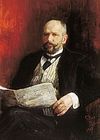
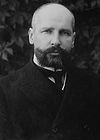
The Tsar came back to his box immediately after the shooting. At that moment Stolypin appeared to remember something; he turned in his direction, made signs of the cross over the tsar's family and himself, and lost consciousness. Doctors present at the theatre were already running to him, among them, Profs. Rein, Chernov, Obolensky, Makovsky, surgeon Galin and Dr. Afanasyev. They stopped the bleeding and carried the wounded on a stretcher to the ambulance. At this moment Stolypin regained his consciousness and uttered: "Tell the Tsar that I am happy to die for him and for my Motherland."
The following article describes the service and times of Petr Stolypin, Russia’s leading statesman in the period following the Revolution of 1905 and Prime Minister and Minister of Internal Affairs from 1906 to 1911, when he died from an assassin's bullet. His hapless murderer was but a tool in the hands of "the mystery of iniquity," which doth already work (2 Thess. 2:7). Stolypin, however, will be ever remembered as a dedicated public servant, with whom not all of his colleagues agreed, but who the people loved. He embodied that nobility of soul of which, perhaps, the present world is not worthy.
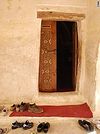
The founders of this monastery were disciples of St. Anthony the Great, widely considered to be the Father of Monasticism because he initiated Christian monastic life as we have come to understand it today. Our guide was Father Ruwais Antony who helped us understand how this 4th century monastery made Egypt the origin for a movement that spread throughout Palestine, Mesopotamia, Persia and ultimately Europe.
Nun Nectaria (McLees)
Rating: 8.2|Votes: 5
Also, he had a sense of humor. For example, some of the sources say that when he first saw the saunas of the Slavs in what is now Novgorod he wrote letters to friends saying, “These Slavs are such strange people; they torture themselves with birch branches.” He was laughing about it. You cannot imagine him as a master of strictness. He was a humorous man, very humble, very easy. As a Mediterranean person he was surprised by these strange traditions. Of course, he was also a man who had seen many things.
Nun Nectaria (McLees), George Alexandrou
Rating: 3.4|Votes: 65
After the dormition of the Mother of God, St. Andrew began his final journey from Jerusalem. The trail of tradition says that he went back to Pontus, then to Georgia, to the Caucuses, and to the Sea of Azov in southern Russia. From there he went to Donets, to the Crimea, up the Dnepr River to Kiev and to the Scythians of the Ukraine. In the Crimea, where he stayed with the Greeks of Sebastopol and Cherson, we know that there were first-century Christian communities organized by St. Andrew himself. From the Crimea and Kiev in the Ukraine, he would have gone north by river to what is now Moscow, to Novgorod and then to Lake Ladoga (Valaam).