


| Previous day | 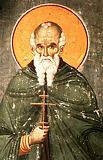
|
Next day |
| Old Style
July 5
|
Friday |
New Style
July 18
|
|
6th Week after Pentecost.
Tone 4.
Fast Day. |
 Wine and oil allowed.
|
 St. Athanasius of Mt. Athos and his six disciples (1000).
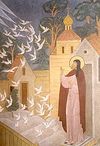
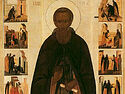
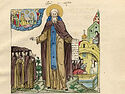
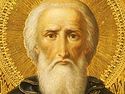
  Uncovering of the relics of St. Sergius of Radonezh (1422).
Martyr Anna, at Rome (ca. 304). Sts. Athanasius and Theodosius, of Cherepovets (both ca. 1388), disciples of St. Sergius of Radonezh. St. Lampadus, monk, of Irenopolis (10th c.).
 New Martyrs Abbess Elizabeth (Romanova) and Nun Barbara, and those with them: John, Igor, Constantine, Sergius, and Vladimir, princes, and Theodore, at Alapaevsk (1918). New Hieromartyr Aristarchus (Sitalo), archimandrite, of Akhtyra (1919). New Confessor Agapitus (Taube), monk of Optina Monastery (1936).
Hieromartyr Stephen, bishop of Rhegium, disciple of Apostle Paul, and with him Bishop Suerus and the women Agnes, Felicitas, and Perpetua (1st c.). Hieromartyr Athanasius, deacon, of Jerusalem (451). St. Morwenna, patroness of Morwenstow (England) (6th c.). New Martyr Cyprian of Koutloumousiou, Mt. Athos (1679). Synaxis of 23 Saints of Lesbos.
Thoughts for Each Day of the Year
According to the Daily Church Readings from the Word of God
By St. Theophan the Recluse

Friday. [I Cor. 4:5-8; Matt. 13:44-54]
Arriving in Nazareth the Lord found no faith there. His visible simplicity hindered the Nazarenes from seeing His invisible glory and divinity. Does not the same occur with a Christian? Christian dogmas are very simple in appearance; but for the mind which enters into them, they represent an all-embracing harmonious system in and of themselves, which were not, nor ever could be generated by any creature’s mind. Proud-mindedness, casting a fleeting glance at the simplicity of the Gospels, is repelled by it and begins to build its own house of knowledge, which it deems enormous and full of broad horizons. It is in fact no more than a towering house of cards, and the horizons are no more than mirages, phantom products of a heated imagination. But there is no point in telling him. He and his brothers are ready with their critical attacks to immediately cast anyone from the mountain into the abyss who tries to dissuade them; but the truth always passes unharmed through their midst and goes on to other souls capable of receiving it.
Articles





 The Heart of a SaintSophie Law“I took up the life I am now leading not as a cross—but as a road full of light God showed me after Serge’s death and which years and years before had begun in my soul." |