| Previous day | 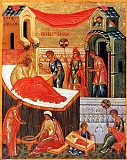
|
Next day |
| Old Style
September 8
|
Sunday |
New Style
September 21
|
| 15th Sunday after Pentecost. Sunday before the Exaltation of the Cross. Tone 6. |  No fast.
|
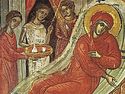
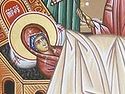
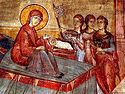
 The Nativity of Our Most Holy Lady the Theotokos and Ever-Virgin Mary.
Sts. Ioane (Maisuradze), archimandrite (1957), and Giorgi- Ioane (Mkheidze), schema-archimandrite (1962), confessors, of Georgia. St. Serapion, monk of Spaso-Eleazar Monastery (Pskov) (1481). St. Lucian, abbot, of Alexandrov (1654).
New Martyr Alexander Jacobson, at Solovki (1930).
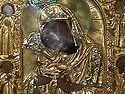
Icons of the Most Holy Theotokos: Syamsk (1524), Glinsk (16th c.), Lukianov (16th c.), and Isaakov (1659). Icons of the Most Holy Theotokos: “Kursk Root” (1295), Pochaev (1559), Domnitsk (1696), Kholmsk (1st c.), and Lesna (1696).
St. Ina, King of Wessex, and his wife Queen Ethelburga (8th c.). New Martyr Athanasius of Thessalonica (1774). St. Sophronius of Achtalea in Georgia, bishop (1803).
Repose of Archbishop Dionysius of Ufa (1896), Elder Daniel of Katounakia, Mt. Athos (1929), and Priest Dimitrie Bejan of Romania (1995).
Thoughts for Each Day of the Year
According to the Daily Church Readings from the Word of God
By St. Theophan the Recluse

The Fifteenth Sunday After Pentecost. [II Cor. 4:6-15; Matt. 22:35-46]
The Lord offered the commandment about love for God and one’s neighbor, and immediately supplemented it with the teaching about His Sonship to God and His Divinity. Why was this? Because true love for God and people is possible no way other than by the influence of faith in the Divinity of Christ the Saviour, that He is the incarnate Son of God. Such faith arouses love for God, for how can one not love God, who has loved us so much, Who did not even spare His Only-Begotten Son, but gave Him up for us? Faith brings this love to complete fulfilment, or to what it seeks; while love seeks a living union. To attain this union, one must overcome a feeling of God’s righteousness which punishes sin; without this it is terrifying to approach God. This feeling is overcome through the conviction that God’s righteousness is satisfied by the death on the cross of the Son of God. Such a conviction comes from faith; consequently, faith opens the path of love toward God. This is the first thing. Second: faith in the Divinity of the Son of God Who was incarnate, suffered, and was buried for our sake, gives an example of love for one’s neighbor; for love is when one lays down his soul for his beloved. Faith also gives strength for the manifestation of such love. To have such love, one must become a new person instead of an egotistical person—one must become a self-sacrificing person. Only in Christ does a person become a new creature; but we can only be in Christ if we unite with Christ by faith and grace-filled rebirth through the holy mysteries accepted with faith. From here it follows that any expectation by people without faith to maintain even good moral conduct is in vain. Everything is together; it is impossible to divide a man. One must satisfy all of him.
Seventeenth Sunday After Pentecost. Sunday Before the Elevation of the Cross. [Gal. 6:11-18; John 3:13-17]
As Moses lifted up the serpent in the wilderness, even so must the Son of Man be lifted up: That whosoever believeth in Him should not perish, but have eternal life. Faith in the Son of God, crucified in the flesh for our sake—is the power of God unto salvation, the living source of vivifying moral aspirations and dispositions, and the receptacle of the abundant grace of the Holy Spirit which abides always in the heart, and of secret inspirations in good time, at the hour of need, sent from above. Faith combines one’s convictions, attracting God’s good will with power from above. Both of these are what make up the possession of eternal life. While this life is kept intact, a Christian is unyielding, because by cleaving to the Lord he is one in spirit with the Lord, and nothing can overcome the Lord. Why do people fall? From weakening of faith. Christian convictions weaken—and moral energy weakens as well. While this weakening occurs, grace is crowded out of the heart, and evil urges raise their head. An inclination toward these urges comes at a convenient hour, and there is a fall. Be a watchful guardian of the faith in everything it encompasses, and you will not fall. In this sense Saint John says that he who is born of God does not sin.
Articles
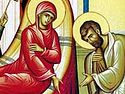
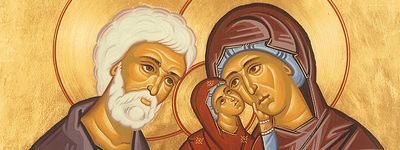 The Nativity of the Mother of God |
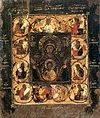
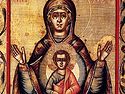 Icon of the Mother of God “Kursk-Root”The Kursk Root Icon of the Mother of God “Of the Sign” is one of the most ancient icons of the Russian Church. |