


| Previous day | 
|
Next day |
| Old Style
October 13
|
Sunday |
New Style
October 26
|
| 20th Sunday after Pentecost. Tone 3. |  No fast.
|
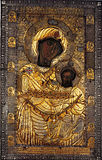
Commemoration of the Holy Fathers of the Seventh Ecumenical Council (787).  Translation to Moscow of the Iveron Icon of the Most Holy Theotokos.
  Hieromartyrs Carpus, bishop of Thyateira, and Papylus, deacon, and Martyrs Agathadorus and Agathonica, at Pergamus (251).
Martyr Florentius of Thessalonica (1st c.-2nd c.). Hieromartyr Benjamin, deacon, of Persia (421-424). St. Nicetas the Confessor, of Paphlagonia (ca. 838). St. Benjamin of the Kiev Caves (14th c.). New Martyr Zlata (Chryse) of Meglin, Bulgaria (1795). St. Anthony, metropolitan of Chkondidi, Georgia (1815), and his disciple James the Elder, hieromonk.
New Hieromartyr Nicholas Yermolov, archpriest, of Ordynskoye (Novosibirsk) (1937). Uncovering of the relics of New Hieromartyr Thaddeus (Uspensky), archbishop of Tver (1993).
Kazan Icon of the Most Holy Theotokos “Of the Seven Lakes” (17th c.).
St. Venantius, abbot, of the monastery of St. Martin in Tours (Gaul) (400). St. Luke of Demena, Sicily (984). Monk-martyr Jacob of Hamatoura Monastery (Lebanon) (late 13th. c.). New Martyr Bosiljka Rajicic of Kosovo (18th c).
Repose of Monk Athanasius of Valaam (1852).
Thoughts for Each Day of the Year
According to the Daily Church Readings from the Word of God
By St. Theophan the Recluse

The Twenty-First Sunday After Pentecost. [Gal. 2:16-20; Luke 8:5-15]
The thorns and thistles which choke the word of Divine truth, in addition to being riches, pleasures and cares of this life, at the current time must also be understood to be various false teachings, spread by scholars who have lost the truth and have been knocked off the path to it. Among us such theories differ much: some publicly and openly go against the truth; others do so by oblique hints that are nevertheless understood by those toward whom they are directed. In essence they act like carbon monoxide poisoning—they enter unnoticeably, and cloud the head, leading to a loss of clear consciousness of everything around. He who gets this carbon monoxide poisoning begins to rave like one who is asleep, for everything already appears to him entirely not as it is, not as it appears to one who is in his right mind. When you meet such a person you see that not only is all truth is suppressed in him, but any feeling for the truth is also stifled, and a lie has penetrated all the components of his mind. How should one be? Do not listen to these ravings or read them; and when they are unwillingly heard or read, throw them out of your head. When they are not thrown out—submit them to reason, and they all will scatter like smoke.
Articles


 Iveron Icon of the Mother of God |

 Martyr Florentius of ThessalonicaThe Martyr Florentius was a native of Thessalonica. |

