| Previous day | 
|
Next day |
| Old Style
November 20
|
Wednesday |
New Style
December 3
|
|
26th Week after Pentecost.
Tone 8.
Nativity Fast. |
 Monastic rule: cooked food, no oil.
|
 Forefeast of the Entry of the Most Holy Theotokos into the Temple. St. Gregory of Decapolis (816). St. Proclus, archbishop of Constantinople (446-447).
Martyr Dasius of Dorostolum in Moesia (284-305). Martyrs Eustace, Thespesius, and Anatolius, of Nicaea (312). Hieromartyr Nerses, bishop of Shahrqart (Kirkuk), and his disciple Martyr Joseph, and those martyred with them in Persia: Hieromartyrs John, Shapur, and Isaac, bishops of Seit Selok; Martyrs Guhshtazad, eunuch, Mari, Sasan, Tima, Noah, and Zaun, of Lashom; and Bautha, Denachis, Thecla, Dinaq, Tatun, Mama, Mazakya, Ana, Abyat, and Hatay (343). St. Diodorus, founder of Yuriegorsk Monastery (Solovki) (1633). St. Parasceva (Rodimtseva), abbess of Toplovsky Convent (Simferopol) (1928).
New Hieromartyrs Macarius (Karmazin), bishop of Dnepropetrovsk, Arsenius (Dmitriev), abbot, of the Tikhvin Monastery, Eutychius (Kachur), abbot, of the St. Marcian Skete (Ukraine), Hilarion (Pisarets), hieromonk of Glinsk Hermitage, Alexis Amanov, archpriest, of Zaraisk (Moscow), Vladimir Medvediuk, archpriest, of Yazvishche (Moscow), Alexis Nikatov, archpriest, of Ignatovo (Moscow), John Savr, archpriest, of Tikhvin, and Alexander Sakharov, archpriest, of Petrovskoye (Ryazan) (1937). Nun Martyr Tatiana (Fomicheva) (after 1937). New Nun-martyr Ioannikia (Kozhevnikova), abbess of the Convent of the Entry of the Theotokos (Tikhvin) (1937).
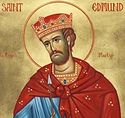
St. Isaac, catholicos of Armenia (440). St. Theoctistus the Confessor, of Constantinople (855). Martyr Edmund, king of East Anglia (869). St. Sozomen of Cyprus (12th c.).
Thoughts for Each Day of the Year
According to the Daily Church Readings from the Word of God
By St. Theophan the Recluse

Wednesday. [I Tim. 5:22-6:11; Luke 18:15-17, 26-30]
Whosoever shall not receive the Kingdom of God as a little child shall in no wise enter therein. How is one to receive it as a little child? Here is how: in simplicity, with full heart, without a moment’s thought. A rational analysis is not applicable in the realm of faith. It can have place only on its threshold. An anatomist divides the whole body into its details, but does not see life. So also reason, no matter how much it reasons, does not comprehend the power of faith. Faith itself provides the contemplations which taken together show that faith completely satisfies all the needs of our nature, and obliges our consciousness, conscience, and heart to receive the faith. They receive it, and having received it, do not want to fall behind. Then, it is like tasting pleasant and healthy food. Having tasted once, we know that it is suitable, and we rank it amongst the nourishing substances. Chemistry does nothing to force this conviction, neither before nor after the tasting. Our conviction is founded upon direct, personal experience. Thus, the believer knows the truth of the faith directly. Faith itself instils in him the unshakeable conviction that it is faith. How, then, could faith be a faith of reason? In this lies the reasonableness of faith, to directly know that it is faith. Reason only ruins things, cooling faith and weakening life according to faith; but the main thing is that it is arrogant, and chases away God’s grace—an evil in Christianity of the first degree.
Thursday. [I Tim. 6:17-21; Luke 18:31-34]
The Lord told the disciples about His suffering, but they did not understand anything He was saying; This saying was hid from them. Later, the faithful determined not to know any thing, save Jesus Christ, and him crucified (I Cor. 2:2). The time had not come, they did not understand any of this mystery; but when the time came—they understood, and taught everyone, and interpreted for everyone. This happens with everyone, not only with relation to this mystery, but to all the other mysteries as well. What is not understood in the beginning, with time becomes understood; it is as if a ray of light enters the consciousness and brightens what was formerly dark. Who elucidates it? The Lord Himself, the grace of the Spirit that lives in the faithful, one’s guardian angel—only in no way the person himself. He is a recipient, and not the cause. On the other hand, another thing may remain incomprehensible for one’s whole life—not only for individuals, but for all of humanity. Man is surrounded by things he does not understand—some are explained to him in the course of his life, while others are left until the next life, where it will be seen. This applies even to minds enlightened by God. Why is it not revealed here? Because some things are incomprehensible, so there is no point in talking about them; others are not told out of considerations for health— that is, it would be harmful to know prematurely. Much will become clear in the other life, but other subjects and other mysteries will be revealed. For a created mind there is never a surplus of inscrutable mysteries. The mind rebels against these bonds: but whether you rebel or not, you cannot sever the bonds of mystery. Become humble, proud mind, beneath the strong hand of God—and believe!
Articles
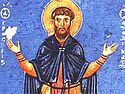
 St. Proclus the Archbishop of ConstantinopleSaint Proclus, Archbishop of Constantinople, from his early years devoted all his time to prayer and the study of Holy Scripture. |

 Martyrs Eustace, Thespesius, and Anatolius of NiceaThe Holy Martyrs Eustathius, Thespesius and Anatolius, natives of the city of Gangra, were the children of a rich merchant. |