


| Previous day | 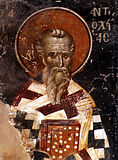
|
Next day |
| Old Style
February 12
|
Wednesday |
New Style
February 25
|
|
1st Week of Great Lent.
Tone 4.
Great Lent. |
 Monastic rule: xerophagy (bread, uncooked fruits and vegetables).
|
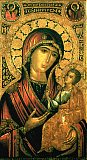
 Appearance of the Iveron Icon of the Most Holy Theotokos (Mt. Athos) (9th c.).
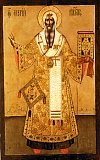
  St. Meletius, archbishop of Antioch (381). St. Alexis, metropolitan of Moscow (1378). St. Meletius, archbishop of Kharkov (1840).
St. Mary, nun (who was called Marinus), and her father, St. Eugene, monk, of Alexandria (6th c.) St. Anthony II, patriarch of Constantinople (895). St. Meletius of Lardos, founder of Ypseni Monastery (late 19th c.). St. Bassian, founder of Ryabovsk Monastery (Uglich) (1509). Hieromartyr Urbanus, pope of Rome (223-230).
New Hiero-confessor Basil (Bogdashevsky), archbishop of Kanev (1933).
St. Ethilwald of Lindisfarne (740). St. Prochorus of Georgia, builder of Holy Cross Monastery near Jerusalem (1066). New Monk-martyrs Luke (Mukhaidze) (1277) and Nicholas (Dvali) (1314), of Jerusalem, and the holy fathers of the Georgian monasteries in Jerusalem. New Martyr Christos the Gardener, of Albania, at Constantinople (1748).
Repose of the cave-dweller Anastasia (Logacheva) of Ardatov (1875).
Thoughts for Each Day of the Year
According to the Daily Church Readings from the Word of God
By St. Theophan the Recluse

Wednesday.
Yea, if thou criest after knowledge, and liftest up thy voice for understanding; if thou seekest her as silver, and searchest for her as for hid treasures; then shalt thou understand the fear of the Lord, and find the knowledge of God (Prov. 2:3–5). The root of a God-pleasing life is fear of the Lord. When it comes to you, then, as a creative force, it will restructure everything within you and recreate in you a beautiful order—a spiritual cosmos. How can you acquire the fear of God? It is in you, only it is smothered. Resurrect it. Give voice to your reason, and open your heart to accept the influence of truth. Until now, your reason was not given a voice—it was enslaved, and did not dare to speak sensibly. Let it now speak. It will begin to speak about God’s omnipotence, which upholds you and could abandon you at any instant; about God’s omnipresence and omniscience, which sees everything within you and is wrathful with you for all that is bad within you; about God’s justice, which is ready to punish you now, but is restrained until the time by His mercy; about death, which at every instant is ready to catch you and give you over to judgement and retribution. Listen and bring your heart to a feeling of these truths. Awaken this feeling—and together with it will come the fear of God. This is the dawn of life.
Articles


 Iveron Icon of the Mother of God |


 Venerable Mary (who was called Marinus), and her father at AlexandriaSaint Mary and her father Eugene lived at the beginning of the sixth century in Bithynia (northwestern Asia Minor). |
 St. Anthony the Patriarch of ConstantinopleSaint Anthony, Patriarch of Constantinople, was a native of Asia, but lived in Constantinople from his youth. |
 St. Bassian of UglichSaint Bassian came to the Protection monastery when he was thirty-three years of age, and was soon tonsured by Saint Paisius. |
