


| Previous day | 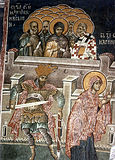


|
Next day |
| Old Style
July 16
|
Wednesday |
New Style
July 29
|
|
9th Week after Pentecost.
Tone 7.
Fast Day. |
 Wine and oil allowed.
|
 Hieromartyr Athenogenes, bishop of Heracleopolis, and his ten disciples (ca. 311).
Martyrs Paul and two sisters, Chionia (Thea) and Alevtina (Valentina), at Caesarea in Palestine (308). Martyr Antiochus, physician, of Sebaste (4th c.). Virgin-martyr Julia of Carthage, at Corsica (440). Commemoration of the Fourth Ecumenical Council (451). St. Theodotus, monk of Glinsk Hermitage (1859). St. Magdalena, schema-abbess of New Tikhvin Convent in Siberia (1934). Synaxis of Russian Saints glorified at the Moscow Councils of 1547 and 1549.
New Confessor Matrona Belyakova, fool-for-Christ, of Anemnyasevo (1936). New Hieromartyrs James (Maskaev), archbishop of Barnaul, and priests Peter and John, and with them Monk-martyr Theodore (Nikitin) and Martyr John (1937). New Hieromartyr Ardalion (Ponamarev), archimandrite, of Kasli (Chelyabinsk) (1938).
Icon of the Mother of God of Chirsk-Pskov (1420).
Martyr Helier of Jersey (6th c.). St. John of Vishnya and Mt. Athos, activist against Uniatism (c. 1630). New Martyr John of Turnovo (1822). 15,000 Martyrs of Pisidia.
Thoughts for Each Day of the Year
According to the Daily Church Readings from the Word of God
By St. Theophan the Recluse

Tuesday. [I Cor. 12:12-26; Matt. 18:18-22; 19:1-2, 13-15]
Wanting to know how many times one should forgive his brother, Saint Peter asked with the suggestion: forgive till seven times? Saying this, he thought that he chose the greatest amount. How short is human patience! The Lord, applying His longsuffering to our infirmities, determined, I say not unto thee, Until seven times: but Until seventy times seven. This is the same as saying: always forgive and do not think about not forgiving. All-forgivingness shall be the distinctive feature of a Christian spirit, as all-forgivingness is the source and constant support of our life in the Lord, from God Himself. Customary forgiving everyone of everything is the outer clothing of Christian love, which according to the Epistle, suffereth long, and is kind, is not easily provoked, beareth all things (I Cor. 13:4-7). It is the most faithful guarantee of forgiveness at the last judgment; for if we forgive, our heavenly Father will also forgive us (Matt. 6:14). In such a manner, if you want to go to heaven—forgive everyone, sincerely, from the bottom of your heart, so that not even a shadow of hostility remains.
Wednesday. [I Cor. 13:4-14:5; Matt. 20:1-16]
In the parable about the hirelings, even he who worked only one hour was rewarded equally to the others by the master of the house. The hours of the day in this parable is an image of the course of our life. The eleventh hour is the final time in this life. The Lord shows that even those who lived without working for Him up to that moment can start to work and please Him no less than others. Therefore, old age is no excuse; let no one despair, supposing that there is no point in starting to work. Start, and do not be cowardly; the Lord is merciful; He will give you all that He gives others, here, according to the measure of grace, and there, according to the rank of truth. Just have more fervour, and grieve more contritely about the carelessness in which almost all of your life was spent. You will say, the master of the house called those in the parable. So, let the Lord call me. But isn’t He calling? Could it really be that you do not hear the voice of the Lord in the Church, saying, come unto Me all ye, and the Apostles’ call, as though God did beseech you by us: we pray you in Christ’s stead, be ye reconciled to God (II Cor. 5:20).
Articles


 Martyr Antiochus the Physician of SebasteThe Holy Martyr Antiochus, a native of Cappadocian Sebastea, was the brother of the holy Martyr Platon (November 18), and he was a physician. |

