


| Previous day | 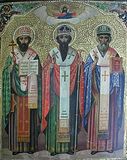
|
Next day |
| Old Style
January 29
|
Wednesday |
New Style
February 11
|
|
Tone 2.
Fast Day. |
 Fish, wine and oil allowed.
|
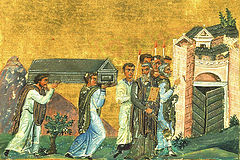
 Translation of the relics of Hieromartyr Ignatius the God-bearer, bishop of Antioch (107).
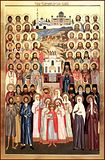
Martyrs Romanus, James, Philotheus, Hyperechius, Abibus, Julian, and Paregorius, at Samosata (297). Hieromartyrs Silvanus, bishop of Emesa, the deacon Luke, and the reader Mocius (Mucius) (312). St. Lawrence, recluse of the Kiev Caves and bishop of Turov (1194). Sts. Gerasimus (ca. 1441-1467), Pitirim (1455) and Jonah (1470) bishops of Perm. Synaxis of the Saints of Komi. Synaxis of the Saints of Ekaterinburg. St. Ignatius, bishop of Smolensk (1210). St. Andrew (Rublev), iconographer, of the Spaso-Andronikov Monastery (Moscow) (1430).
Holy Hieromartyrs Ioann (Granitov) and Leonty (Klimenko), priests, Konstantin (Zverev), deacon, and five martyrs with them (1920).
Martyrs Sarbelus [Thathuil] and his sister Bebaia, of Edessa (98-138) St. Barsimaeus the Confessor, bishop of Edessa (2nd c.). St. Aphrahates the Persian, hermit, of Antioch (370). St. Gildas the Wise, abbot, of Rhuys, Brittany (ca. 570). St. Severus (Sulpitius I), bishop of Bourges (591). St. Ashot Kuropalates of Tao-Klarjeti, Georgia (829). New Martyr Demetrius of Chios, at Constantinople (1802).
Thoughts for Each Day of the Year
According to the Daily Church Readings from the Word of God
By St. Theophan the Recluse

Wednesday. [I John 3:21–4:6; Mark 14:43–15:1]
If help is needed, ask. “I asked,” you say, “and it was not given.” But then how is it given to others? With the Lord there is no respect of persons; to give to one, and not to give to another without any reason. He is ready to give to all—for He loves to be giving. If He does not give to someone, the reason is not in Him, but in the one asking help. Among such reasons can be some that we cannot even guess. But there exist known reasons, visible to anyone. One of these reasons (and is it not the chief reason?) Saint John points out to be the absence of confidence, and the absence of confidence comes from the condemnation of the heart or the conscience. Beloved, he says, if our heart condemn us not, then have we confidence toward God. And whatsoever we ask, we receive of Him, because we keep His commandments, and do those things that are pleasing in His sight (I John 3:21). There is nothing more to add to these words. Everything is clear in and of itself. What master will help an unfaithful servant, a squanderer and profligate? Will the Lord really indulge us when we do not want to please Him and fulfil His commandments; if we only start praying when an extreme need arises?!
Thursday. [I John 4:20–5:21; Mark 15:1–15]
This is the victory that overcometh the world, even our faith (I John 5:4)—the Christian faith. To overcome the world—what does that mean? Not to exterminate all those who love the world, or to annihilate and destroy all which is loved by the world. It means rather that while living amidst those who love the world and moving amidst customs loved of the world, we live and be alien to everyone and everything. As soon as you have rejected the world and everything worldly, you have by this very action overcome the world. But who teaches you to reject the world and who gives you strength for this? Our [Orthodox] Faith gives the strength. It discloses the destructiveness of the delusions of the world and inspires the desire to free oneself of their nets. Then, when one resolves to break these bonds, repents and approaches the Mysteries of renewal—baptism or repentance—faith allows him to mystically feel the sweetness of a life opposed to the world, a sweetness with which all the pleasures of the world cannot in any way enter into comparison. As a result, a loathing for everything worldly dwells in the heart, which actually is overcoming the world. But in this mystical action, as a result of which loathing for the world is born, the power to steadfastly abide in this loathing and alienation from the world also is granted; and this is a victory decisive and lasting.
Articles


 St Pitirim the Bishop of PermSaint Pitirim, Bishop of Great Perm, was chosen and consecrated to the See of Perm after the suffering and death of St Gerasimus of Perm. |

 Saint Ignatius, Wonderworker and Bishop of SmolenskSaint Ignatius was the first bishop of Smolensk. |
 Holy Hieromartyrs Priests Ioann and Leonty, Deacon Konstantin, and Five Martyrs with ThemAmid the torture, the priest cried out to the Orthodox believers: “Do not renounce God!” |

 Saint Aphraates of PersiaSaint Aphraates, a Persian who came to believe in Christ, disavowed his illustrious lineage and left his pagan countrymen by going to Edessa, and then to Antioch. |

